7 Things That Actually Matter in a Hands-Free Leash
Choosing a hands-free dog leash sounds simple until you start comparing them. Waist or crossbody? Six feet or eight? Braided or minimalist? Adjustable or fixed? Lightweight or more substantial?
And then there’s the question that matters more than all of those: What are you actually going to do with it?
A hands-free leash for neighborhood walks is not necessarily the same leash we'd choose for a rainy six-mile hike in the Pacific Northwest. And around here, "rainy hike" isn't some occasional edge case. It's Tuesday.
The best hands-free dog leash isn't simply the one that lets you stop holding a handle. It should fit your body, your dog, and the way you actually move together while still giving you the ability to step in and handle the leash directly when needed.
Before you worry about color or hardware finish, our team at Bolder K9 has put together a list of the seven things we'd look at first.
1. Decide How You Actually Want to Wear It
Most hands-free dog leashes can be worn around the waist, across the body, or both.
Neither position is automatically better.
Crossbody wear runs diagonally across your torso. Some handlers prefer it for everyday walks, errands, training, and hiking because the connection feels higher and the leash tends to move naturally with your body.
Waist wear keeps the connection lower around your hips. That can feel comfortable for longer walks and steady forward movement, especially when you want your upper body completely free.
But here's the part that gets missed: your body changes the leash.
A six-foot person in a winter shell wearing a leash crossbody is going to use up more leash around their body than a smaller handler wearing the same setup around the waist.
Your preferred clothing matters too.
We build gear in Washington, so we think about this more than someone shopping exclusively for sunny sidewalk walks. A leash that fits perfectly over a T-shirt may feel completely different over a fleece, insulated jacket, and rain shell.
If you plan to use your leash year-round, make sure there's enough adjustment range to accommodate how you actually dress and move.
2. Pay Attention to Working Length, Not Just Total Length
This is probably the most overlooked part of buying a hands-free leash.
A leash may be listed as six, eight, or ten feet long, but once part of that leash goes around your waist or across your body, all of that advertised length is no longer between you and your dog.
Some of it is now wrapped around you.
That's your working length.
Two people can therefore wear the exact same leash and end up with noticeably different distances between themselves and their dogs.
And that distance matters.
Too much leash on a narrow trail can be annoying. Too little leash can make relaxed walking feel restrictive. On a busy sidewalk, you may want your dog considerably closer than you would on an open hiking trail.
Your dog's height also changes the equation. A leash attached to a tall shepherd isn't creating the same geometry as one attached to a small terrier.
Don't shop only by the number in the product title, think about how much leash remains after you're wearing it.
3. Match the Setup to the Dog on the Other End
Hands-free doesn't mean passive.
In fact, attaching a dog to your body makes it even more important to be realistic about the dog you're handling.
Consider:
- Your dog's size
- Your dog's strength
- How reliably your dog walks with you
- Whether your dog suddenly changes direction
- How often you need to shorten the leash
- Where you'll actually be using it
A small, steady dog walking through the neighborhood creates a very different handling situation from a powerful dog launching toward a squirrel at the edge of a wet trail.
That doesn't mean large or energetic dogs can't use hands-free leashes.
It means the leash design, hardware, working length, training, and handler skill matter more as the forces involved increase.
And this is where we'd add one important reality check:
A hands-free leash does not teach leash manners.
If your dog currently pulls hard for the entire walk, transitioning immediately to clipping that force around your waist or torso probably isn't the best first step. Teach the walking skills first.
Then let the equipment make an already-functional system more convenient.

4. Make Sure You Can Get Your Hands Back on the Leash
This sounds contradictory, but one of our favorite features of a good hands-free setup is the ability to stop being hands-free, because actual dog walks aren't static.
You're cruising down an empty trail, and suddenly there's another dog around the corner.
You're walking through town and hit a busy intersection.
A cyclist comes up behind you.
You walk out of the woods and into a packed trailhead.
That's when you want to be able to grab, shorten, or actively handle the leash quickly.
We don't think "hands-free" should mean hands-off.
It should mean your hands are available when the situation allows it—and your leash is still manageable when the situation changes.
Look at where the grab points sit when you're actually wearing the leash.
A handle can look great in a product photo and still be frustrating if it's positioned somewhere you can't comfortably reach.
The best setup gives you freedom without making direct control inconvenient.
5. Decide How Much Adjustability You Really Need
More features aren't always better.
More adjustment points can make a leash extremely versatile. But they can also mean more hardware, more bulk, and more leash than a minimalist handler actually wants.
On the other hand, a very simple leash may feel fantastic if you already know exactly how you like to wear it—but frustrating if you're constantly changing configurations.
Think about your routine.
Do you switch between waist and crossbody wear?
Does one leash get used by two different people?
Do you want to shorten it for downtown walks and open it up on trails?
Do you want the option to convert back to a traditional handheld leash?
If yes, adjustability is worth prioritizing.
If you basically want to clip in, throw the leash over your shoulder, and go, a minimalist design may make far more sense.
Choose the amount of adjustability you're actually going to use.
A twelve-function piece of gear isn't automatically better than a three-function piece of gear if you only use two of them.
6. Think About What Happens When It Gets Wet
This one is personal for us. We're based in the Pacific Northwest.
We know the kind of hike where it isn't technically raining hard enough to cancel, but it is raining hard enough that your dog is wet, your jacket is wet, your pack is wet, and the trail has somehow become 40% mud.
That is not the moment you want your leash absorbing water.
And with a hands-free leash, this matters even more because you're wearing the leash against your clothes.
Traditional fabric webbing can absorb moisture and hold dirt and odor. Genuine BioThane® coated webbing doesn't absorb water in the same way and is easy to wipe or rinse clean.
That makes a noticeable difference if you're regularly walking or hiking in:
- Rain
- Mud
- Snow
- Wet grass
- Beaches
- Streams
- Puddles that your dog absolutely did not need to walk through but somehow did anyway
It also makes cleanup easier when you get home.
Rinse it.
Wipe it down.
Let the hardware dry properly.
Move on with your life.
BioThane® still isn't maintenance-free. Hardware and connection points should be inspected and cared for just like any other piece of working dog gear.
But if you routinely come home looking like the weather won, material choice matters.
7. Buy for Your Real Life
This may be the most important question in the entire article:
What do you actually do with your dog?
Not what you might do someday.
Not the epic backpacking trip currently living in your imagination.
What do you do on an average Tuesday?
If most of your walks are around town
Prioritize comfort, adjustability, easy handling, and low bulk.
You probably don't need the most elaborate setup available.
You need something you'll want to put on every day.
If you're hiking regularly
Adjustability, cleanability, weather resistance, and handling options move higher on the list.
Trails change. One minute you're on a wide forest road. Ten minutes later you're stepping over wet roots while holding a trekking pole and wondering why you thought hiking in February sounded fun.
This is exactly where hands-free handling can shine.
You can use your hands for balance, trekking poles, opening gates, grabbing water, or scrambling over an obstacle while still staying connected to your dog.
If you're running
Think carefully about body position and working length.
A dog should already understand how to move predictably with you before you add speed.
A hands-free leash can support running.
It doesn't teach running etiquette.
If you're training
Hands-free handling can keep your hands available for rewards, tug toys, markers, or other equipment.
That can be genuinely useful.
But the leash remains management equipment. It isn't replacing training.
If you have a strong or high-drive dog
Prioritize handling and control. Look at construction, hardware, working length, and how quickly you can physically grab the leash.
Don't choose equipment based purely on whether somebody describes it as "heavy duty."

The Quick Buying Checklist
Before buying a hands-free leash, ask yourself:
| Question | Why It Matters |
| How do I want to wear it? | Waist and crossbody setups feel different. |
| How much working length will I actually have? | Your body uses part of the total leash length. |
| Does the setup suit my dog's size and behavior? | Different dogs create different handling demands. |
| Can I grab or shorten it quickly? | Hands-free shouldn't eliminate direct handling. |
| How much adjustability do I need? | More versatility usually means more hardware. |
| What happens when it gets soaked or muddy? | Material matters a lot more once you're wearing it. |
| Does this fit what I actually do with my dog? | Your real routine matters more than the feature list. |
Once you can answer those questions, choosing between hands-free designs becomes a lot easier.
Which Bolder K9 Hands-Free Leash Should You Choose?
This is where things get fun. We don't make six hands-free options because we think everyone needs six leashes.
We make them because different handlers want very different things from a hands-free setup.
Some people want almost no hardware.
Some want adjustability.
Some want braided construction.
Some already own a leash they love and just want to wear it.
Here's how we'd break down the current lineup.
Voyager Hands-Free: The Flagship Minimalist
If you want the simplest place to start, this is it.
The Voyager is our flagship hands-free design and probably the best representation of what a good everyday hands-free leash should be: clean, adjustable, versatile, and not overloaded with unnecessary hardware.
It's made from 3/4-inch Super Heavy BioThane® and uses an adjustable sliding tab with an integrated O-ring. You can configure it crossbody, over the shoulder, around the waist, or convert it back into a more traditional handheld leash.
It also works as a hitch-style leash when needed.
This is the leash we'd point most people toward when they say:
"I want a hands-free leash, but I don't want something complicated."
Best for:
- Everyday walks
- Around-town use
- Training
- Travel
- Light hiking
- Handlers who like clean, minimalist gear
- People buying their first hands-free leash
If you want versatility without turning your leash into a hardware collection, the Voyager hits a very useful middle ground.
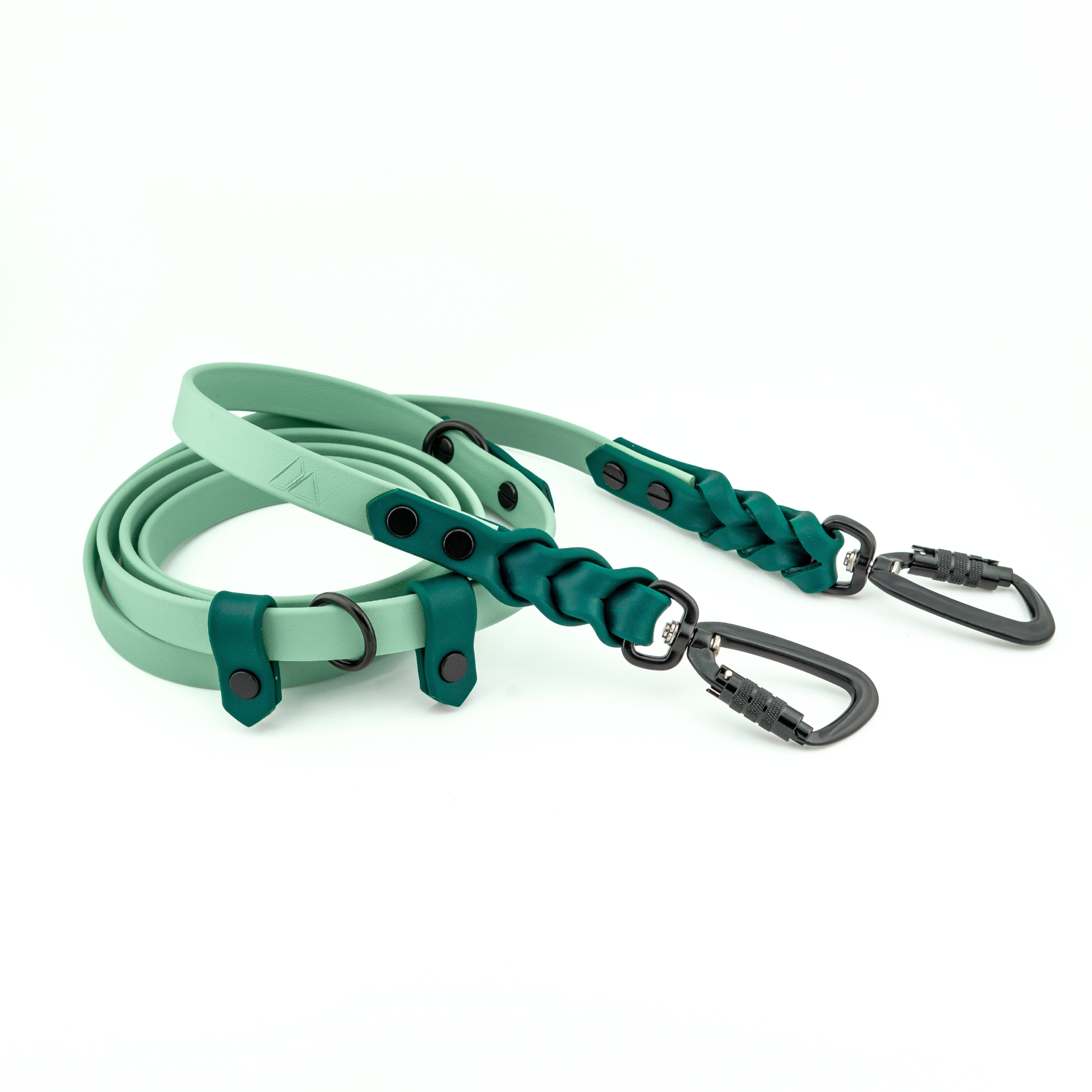
Trailblazer Hands-Free: The Premium Braided Option
The Trailblazer takes the hands-free concept in a more premium, adventure-oriented direction.
This is the one for handlers who like the practicality of BioThane® but want more visual structure, braided detailing, and a more substantial overall design.
The braided construction isn't just about making the leash look different. It changes the character of the leash and gives the Trailblazer its distinct, premium feel.
This is the leash we'd reach for when the weekends involve more forest than sidewalk.
Especially around here.
If your normal adventure includes wet trails, muddy trailheads, rain jackets, and throwing a filthy leash into the back of your car at the end of the day, waterproof construction starts feeling less like a feature and more like common sense.
Best for:
- Hiking
- Camping
- Longer outdoor adventures
- Working and sport-dog handlers
- Handlers who prefer braided details
- People who want a premium-feeling hands-free setup
The Trailblazer is intentionally more substantial than our minimalist options.
If that's what you want, great.
If your priority is the lightest, cleanest leash possible, one of the next options may suit you better.
Atlas Hands-Free: Minimalism With a Little More Presence
Think of the Atlas as sitting somewhere between the Voyager and Trailblazer.
It shares much of the practical versatility of the Voyager—adjustable hands-free wear, waist or crossbody configurations, and the ability to convert between carrying styles—but it has the more substantial Atlas identity.
The live Atlas design uses 3/4-inch Super Heavy BioThane® and the same general sliding adjustment concept, but it's positioned for handlers who want clean functionality with a more rugged presence.
So if you like the Voyager concept but want something that feels a little more substantial, Atlas is the logical step.
Best for:
- Everyday walking
- Larger or high-drive dogs
- Training
- Hiking
- Handlers who like minimalist design but want a more substantial build
- People stuck between Voyager and Trailblazer
If Voyager feels slightly too simple and Trailblazer feels slightly too elaborate, Atlas is probably where we'd look.
BioThane® Rope Hands-Free: The Lightweight Minimalist
This one takes the minimalist idea even further.
The BioThane® Rope Hands-Free Leash uses 1/4-inch BioThane® rope rather than flat webbing, which creates a noticeably lighter, lower-profile setup.
You can wear it crossbody, over the shoulder, or around your waist.
And because the rope is waterproof and easy to clean, it retains one of the biggest practical advantages of BioThane® without the feel of a wider leash.
This is a great option for people who put on a traditional hands-free leash and immediately think:
"This is more leash than I want hanging off me."
Best for:
- Everyday walking
- Lightweight setups
- Smaller or medium dogs
- Errands and casual adventures
- Handlers who dislike bulky gear
- Wet-weather walks where you still want minimal weight
It also has a very different visual feel from flat BioThane®.
If you like the classic look of rope but don't like wet rope soaking up water and funk, this is a pretty nice solution.
ECO Hands-Free: Simple and Extremely Adjustable
The ECO is the oddball of the group—in a good way.
Instead of adding more components, it takes the opposite approach.
The ECO Hands-Free Leash uses one clip and an adjustable body loop, and the total length adjusts from approximately 5 to 10 feet.
That's a huge adjustment range.
So if your main priority is being able to change the effective leash length dramatically without buying a more complicated system, the ECO deserves a serious look.
It's straightforward, waterproof BioThane®, and intentionally stripped down.
Best for:
- Handlers who want broad length adjustment
- People who prefer extremely simple gear
- Everyday walking
- Hiking
- Multiple wearing preferences
- Anyone who doesn't need a lot of extra hardware or attachment points
The defining question is simple:
Do you want a bunch of different features?
Or do you mostly want one leash that can get much shorter or much longer?
If it's the second answer, that's ECO.
Hands-Free Adapter: Keep the Leash You Already Like
This may actually be the smartest option for a lot of people.
If you already own a standard leash you love, you don't necessarily need to replace it just to go hands-free.
The Hands-Free BioThane® Adapter functions as an adjustable belt or shoulder sash that gives an existing leash a hands-free attachment point.
Clip your leash to the adapter.
Adjust it to your body.
Done.
It can also integrate into setups involving more than one leash, which makes it particularly useful for trainers or handlers who prefer modular equipment.
Best for:
- People who already own a favorite leash
- Trainers with multiple leash setups
- Handlers who want modular gear
- Households with several different leash types
- Anyone who wants hands-free capability without replacing existing equipment
This is the option people sometimes overlook because it isn't technically a complete leash.
But that's exactly why it's useful.
You aren't locked into one leash.
You're adding hands-free capability to gear you already use.
The Simple Version
If you're still staring at six options and thinking, Okay, but which one do I buy?, here's our shortest answer:
Choose Voyager if you want our flagship minimalist everyday option.
Choose Trailblazer if you want the premium braided setup for hiking, working dogs, and bigger adventures.
Choose Atlas if you want something between Voyager and Trailblazer: clean and minimalist, but a little more substantial.
Choose BioThane® Rope Hands-Free if low weight and minimal bulk matter most.
Choose ECO if you want a very simple leash with a huge adjustable length range.
Choose the Hands-Free Adapter if you already own a leash you love.
That's really it.
You don't need the fanciest leash.
You need the one whose tradeoffs make sense for you.
A Quick Note Before You Go Hands-Free
We love hands-free leashes.
We also think they're much more enjoyable when your dog already has some leash skills.
If your dog spends the entire walk leaning into the leash, zig-zagging unpredictably, or launching toward every distraction, attaching that behavior directly to your torso isn't going to magically improve the walk.
Work on the foundation first.
Teach your dog how to move with you, respond to leash pressure, maintain an appropriate working distance, and come back into position when needed.
Then transition to hands-free in a familiar, low-distraction environment.
That's when the leash becomes what it's supposed to be:
a convenience—not a workaround for missing training.
Why We Keep Coming Back to Hands-Free Leashes in the PNW
There are plenty of places where a hands-free leash is convenient.
The Pacific Northwest just happens to be particularly good at showing you why.
You're halfway up a trail. It's raining. One hand has a trekking pole. The other is trying to adjust your hood. Your dog is marching happily through something that may technically qualify as a creek.
At that moment, having the leash secured around your body instead of occupying one of your hands makes a whole lot of sense.
So does having waterproof gear. A genuine BioThane® hands-free leash won't prevent you from getting soaked.
We haven't figured that one out yet.
But at least your leash doesn't need to spend the next two days drying over the shower rod.

Frequently Asked Questions About Choosing a Hands-Free Dog Leash
How do I choose the right hands-free dog leash?
Start with how you'll use it. Consider how you want to wear it, your actual working length, your dog's size and leash skills, how quickly you can grab the leash, the level of adjustability you want, and the conditions where you'll use it.
Is a waist or crossbody leash better?
Neither is universally better. Waist wear keeps the attachment lower around your hips, while crossbody wear positions it across your torso. Your build, clothing, activity, dog, and preferred working length can all influence which feels better.
Should my dog know how to walk on leash before using a hands-free leash?
Ideally, yes. Your dog doesn't need to be perfect, but basic leash skills make hands-free walking much easier and more predictable. A hands-free leash should support established leash handling—not compensate for constant pulling.
How long should a hands-free dog leash be?
There isn't one perfect length because your body uses part of the leash when you wear it. Think in terms of working length, meaning the distance remaining between your body and your dog once the leash is configured.
Are hands-free leashes good for hiking?
They can be extremely practical for hiking because they keep your hands available for trekking poles, balance, opening gates, carrying gear, or navigating obstacles. Training, terrain, working length, and your dog's behavior still matter.
What type of hands-free leash is best for rain?
A waterproof, easily cleaned material can be particularly useful. Genuine BioThane® doesn't absorb water like many fabric webbings, making it practical for wet trails, muddy walks, snow, beaches, and rainy climates.
What's the simplest Bolder K9 hands-free leash?
That depends on what kind of simplicity you mean. Voyager is our flagship minimalist flat-BioThane® option. BioThane® Rope is particularly lightweight and low-profile. ECO eliminates much of the extra hardware while offering a very large adjustment range.
Can I convert my existing leash into a hands-free leash?
Yes. The Bolder K9 hands-free adapter is designed specifically to add a wearable belt or shoulder attachment point to an existing leash.
The Bottom Line
Don't choose a hands-free leash just because it has the longest feature list. Choose it because its fit, working length, construction, adjustability, material, and level of control match the way you and your dog actually live.
For one person, that's a minimalist Voyager on a neighborhood walk.
For someone else, it's a braided Trailblazer covered in mud after five miles of Washington trail.
Another handler may want nothing more than a lightweight rope leash. And someone who already owns the perfect leash may just need an adapter. That's exactly why there shouldn't be one universal "best" hands-free dog leash.
There should be a best one for you. You can compare the full lineup in our hands-free dog leash collection, or use our guide to the best hands-free dog leashes if you want a faster side-by-side starting point.
Be sure to check out Bolder K9 on Instagram!