What They’re For, What Length to Buy & How to Use One
A six-foot dog leash is great—until you actually want your dog to have some room. Maybe you're working on recall. Maybe you want your dog to sniff and explore without immediately graduating to off-leash freedom. Maybe you're training tracking or scent work. Or maybe you simply have a dog who would enjoy twenty feet of trail while you'd prefer they didn't disappear twenty acres into the woods.
That's where the long line comes in.
A long line is exactly what it sounds like: an extra-long leash designed to give your dog more distance from you while maintaining a physical connection. Depending on the length and design, long lines can be useful for recall training, decompression walks, tracking, scent work, hiking, puppy training, and giving dogs more controlled freedom outdoors.
But longer isn't automatically better.
The right long line depends on what you're doing, where you're doing it, how experienced you are at handling extra line, and how much freedom your dog is ready for.
Our team at Bolder K9 is going to decode the whole thing.
What Is a Long Line for Dogs?
A long line is a leash that's substantially longer than the standard leash you'd use for everyday walking.
Instead of keeping your dog within roughly four to six feet of you, a long line allows them to move farther away while you retain a physical connection.
That distinction matters.
A long line isn't really meant to turn a normal neighborhood walk into a 30-foot neighborhood walk. In busy areas, around traffic, on crowded trails, or anywhere you're constantly passing people and dogs, all that extra leash can quickly become more problem than benefit.
Long lines shine when you have space.
Think:
- Open fields
- Large parks where leash rules permit them
- Quiet trails
- Recall training areas
- Tracking fields
- Scent-work environments
- Large yards
- Low-traffic outdoor spaces
If you're trying to decide between a standard leash and something longer, our dog leash length guide breaks down where shorter everyday leashes fit into the equation.
Why Use a Long Line?
The simplest answer is controlled freedom.
Your dog gets more opportunity to make choices, sniff, explore and move naturally, but you haven't completely removed the physical connection between dog and handler.
That's useful in more situations than people realize.
Recall Training
This is probably the use most people associate with long lines.
You've practiced "come" in the kitchen.
Then the living room. Then the backyard.
Everything is going beautifully, then you go to a field and apparently your dog has never heard their name before.
Welcome to distractions.
A long line lets you gradually increase distance and environmental difficulty without immediately testing your dog's recall completely off leash.
The goal isn't to use the line to drag your dog back to you. It's there to help you manage the environment while you build the behavior you actually want.
Decompression and Sniffing Walks
Not every walk needs to be a perfect heel down the sidewalk.
In an appropriate open area, a long line gives your dog space to sniff, investigate and move around while remaining connected to you.
For dogs accustomed to standard leashes, that extra radius can completely change how they experience an outing.
You still need to manage the line. Your dog isn't technically off leash. But they have significantly more choice about where they move within the available space.
Puppy Training
Long lines are ridiculously useful with puppies.
They give you a middle ground between keeping a puppy right beside you and giving a young dog more freedom than they're prepared to handle.
You can work on:
- Recall
- Name recognition
- Check-ins
- Following handler movement
- Exploring new environments
- Engagement around distractions
For puppies and inexperienced handlers, starting shorter is usually easier. You can always add distance later.
Hiking and Exploring
In wide, low-traffic areas where longer leashes are permitted, a long line can give a dog additional room to explore.
The important part is choosing the environment carefully.
A 20- or 30-foot line on an open trail is one thing. A 30-foot line on a narrow trail with mountain bikes, other dogs, switchbacks, roots and five people trying to pass you is another.
Sometimes more leash gives you more freedom. Sometimes it just gives you 30 feet of chaos.
Tracking, Trailing and Scent Work
This is where long lines move from "useful training leash" into specialized working equipment.
Tracking and trailing require the dog to work farther ahead of the handler, and the line becomes part of the communication and handling system.
The construction can matter here, too. A tracking line may intentionally omit a traditional handle so the end can travel across the ground with less chance of catching on brush, roots and other obstacles.
How Long Should a Dog Long Line Be?
"How Long Should a Dog Line Be" is probably the biggest question people have before buying one.
There isn't one perfect length.
A better question is:
How much distance can you comfortably manage while still accomplishing your training goal?
Here's a practical starting point.
| Length | Best For | What to Know |
| 10 feet | Puppies, beginners, smaller spaces, early recall work | Easy to manage without a mountain of extra line |
| 15–20 feet | Recall training, sniff walks, general long-line use | A versatile middle ground for many dogs and handlers |
| 30 feet | Advanced recall, larger open spaces, more experienced handlers | More freedom, but substantially more line to manage |
| 30+ feet | Tracking, trailing and specialized training | Best when the activity actually requires the extra distance |
10 Feet: The Starter Length
If you're new to long lines, don't underestimate ten feet.
It doesn't sound dramatically longer than a normal leash, but it gives your dog noticeably more freedom while keeping line management relatively simple.
It's especially practical for puppies, dogs just beginning recall work, smaller training spaces, or handlers learning how to feed and gather line smoothly.
15–20 Feet: The Sweet Spot for Many Dogs
If someone wants one long line for general-purpose training and outdoor exploration, this is often the range we'd look at first.
There's enough distance for meaningful recall practice and sniffing without creating quite as much line management as you'll have at 30 feet or beyond.
It's also a useful length for dogs who aren't ready for true off-leash freedom but don't need to spend an entire outing six feet from your leg.
30 Feet: When You Want Real Distance
Thirty feet opens up a lot more space.
That's great when you're intentionally working recalls at distance or allowing a dog to explore a large open area.
But here's the tradeoff:
You now have 30 feet of leash to manage.
That's a skill. You'll need to pay attention to slack, obstacles, other people, other dogs, your dog's speed and where that line is relative to everyone's legs.
If you're fighting with the leash more than you're training the dog, go shorter.
Longer isn't an upgrade. It's a different tool.
Beyond 30 Feet: Specialized Territory
Extra-long lines can be extremely useful for tracking, trailing and specialized training, but most everyday dog owners don't need maximum length simply because it's available.
Choose length based on the job.
That's a theme you'll hear from us a lot because it applies to nearly every piece of dog gear:
More isn't automatically better. The right tool for the job is better.

Why BioThane® Makes Sense for Long Lines
A standard six-foot leash spends most of its life between your hand and your dog.
A long line? That thing is going on the ground, through grass, across mud, over wet trails, and possibly through a puddle your dog absolutely did not need to walk through—but chose anyway.
BioThane® is especially practical for long lines because it doesn't absorb water and odors the way many traditional fabric materials can. After a muddy training session, you can clean it rather than bringing half the trail home embedded in the leash.
It also remains flexible in wet and cold conditions, which matters when you're actively feeding and gathering a substantial amount of line.
That's a big reason all three long lines currently in the Bolder K9 lineup use BioThane®.
So...Why Does Bolder K9 Have Three Different Long Lines?
Because "I need a long line" doesn't tell us enough.
The person teaching their puppy recall in a field doesn't necessarily need the same setup as the Search & Rescue handler working through brush.
Here's the breakdown.
Element BioThane® Long Line: Keep It Simple
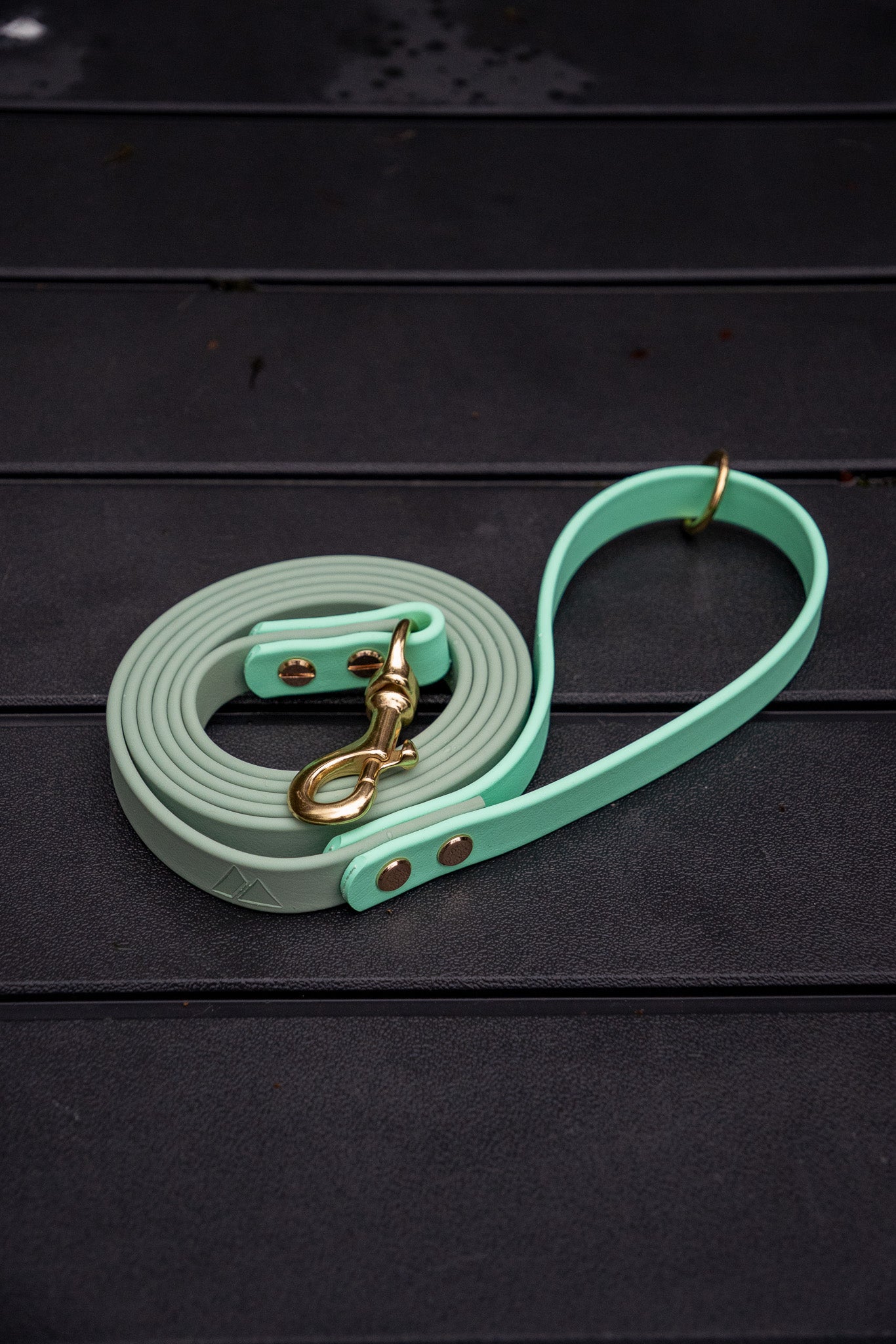
The Element BioThane® Long Line is our original long line and the simplest of the three.
It's built from 5/8-inch Beta BioThane® with a straightforward, no-frills design. It was originally created for fosters and adopters through True North GSD Rescue, and that history still sums up what the Element does best:
Function first.
It's a strong choice for:
- Everyday recall training
- Puppies
- Decompression walks
- Hiking and exploring
- Foster and rescue dogs
- Handlers who simply want a dependable long line without extra complexity
If you don't need specialized tracking construction or a two-tone design, start here.
Atlas BioThane® Long Line: Same Function, More Personality
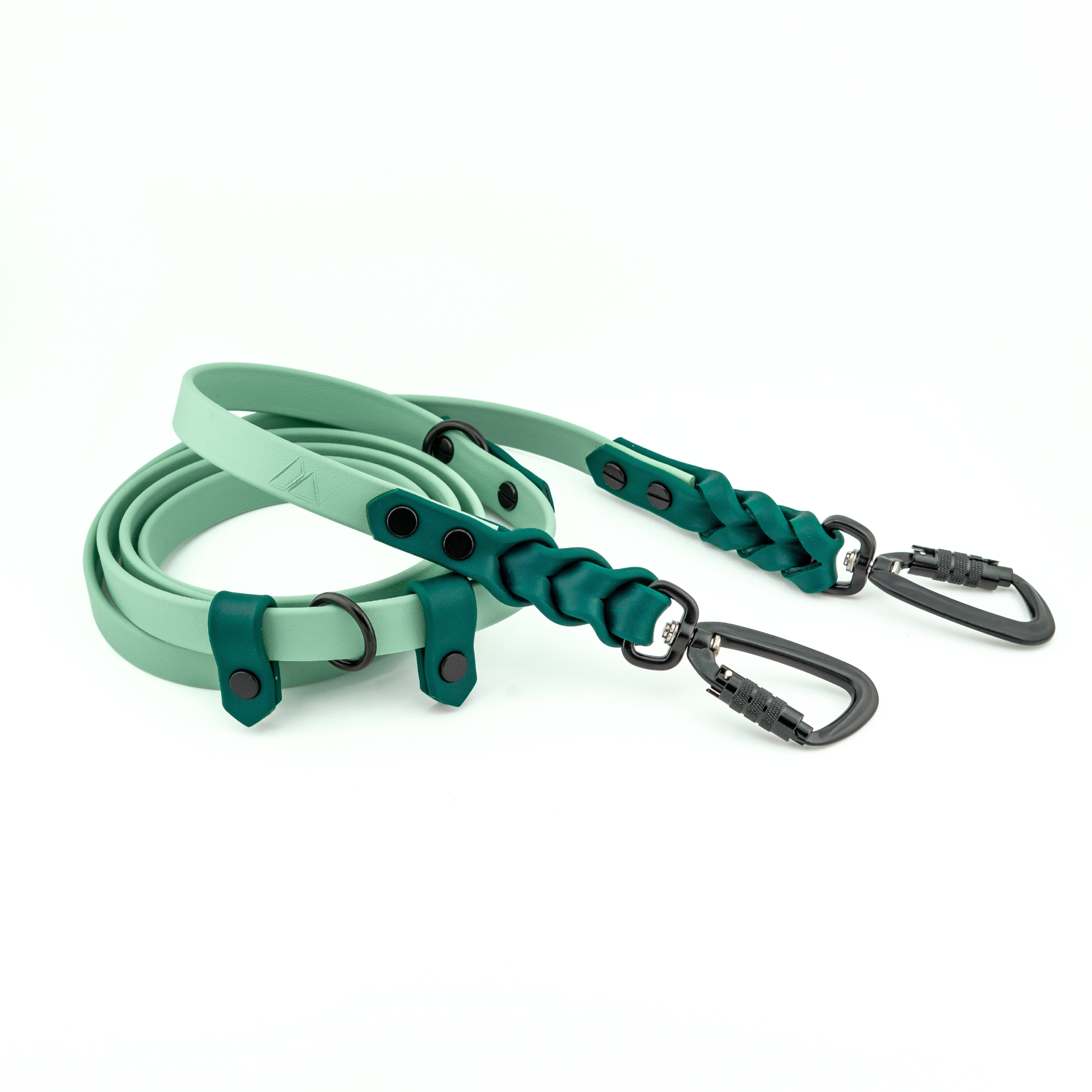
The Atlas BioThane® Long Line uses the same 5/8-inch Beta BioThane® foundation as the Element but adds a contrasting accent color at the handle and clip.
Functionally, it's still built for recall training, decompression walks, hiking and general extended-distance work.
The main difference is customization.
Choose the Atlas if you want the everyday versatility of the Element but prefer a two-tone setup and additional hardware choices.
Because practical gear doesn't have to be boring.
Professional BioThane® Tracking Line: Built for Serious Work
Then there's the Professional BioThane® Tracking Line.
This is a different animal.
It's made from heavier 3/4-inch Super Heavy BioThane® and designed specifically around tracking, trailing, scent detection, Search & Rescue training, advanced obedience and working-dog applications.
It's also intentionally built without a handle by default.
That isn't an omission.
A loop dragging through brush, roots and rough terrain creates something else that can snag. Removing it allows the end of the line to move more cleanly across the ground while the dog works. A handle can still be added if you want one.
The Professional Tracking Line also uses stitched construction with TEX 135 bonded thread and protective PVC wrapping over high-wear stitched areas.
Choose this line when you're doing work that actually benefits from the heavier construction and tracking-specific design.
For casual sniff walks around an open field?
You probably don't need it.
And that's okay.
Element vs. Atlas vs. Professional: Which Long Line Should You Buy?
| Long Line | Best For | Material | Defining Feature |
| Element | Everyday training, recall, puppies, decompression | 5/8" Beta BioThane® | Simple, functional original |
| Atlas | Everyday training + customization | 5/8" Beta BioThane® | Two-tone design and hardware options |
| Professional Tracking Line | Tracking, trailing, scent work, advanced training | 3/4" Super Heavy BioThane® | Heavier construction + handle-free tracking design |
If you're still stuck between them, don't overcomplicate it.
Want simple? Element.
Want simple with more customization? Atlas.
Actually tracking or doing demanding professional work? Professional.
How to Handle a Long Line Without Creating a Giant Mess
The first time someone uses a long line, there's often a moment when they realize:
"Oh. I have to do something with all of this leash."
Yes.
Long-line handling is a skill.
Keep the excess line organized rather than wrapping it tightly around your hand. Feed line out as your dog moves away and gather it as they come closer.
Pay attention to where the line is at all times, especially around:
- Your legs
- Your dog's legs
- Other dogs
- Other people
- Trees
- Brush
- Benches
- Trail obstacles
Avoid grabbing a fast-moving line with bare hands or allowing it to wrap around fingers, wrists or legs. A dog accelerating at the other end can create force quickly.
And don't give your dog 30 feet of runway toward the end of the leash.
The line should help you manage distance—not create a situation where your dog reaches full speed and suddenly hits the end.
For general long-line exploration, a well-fitted back-clip harness can also be a practical attachment point, particularly when a dog may build speed or reach the end of the available line.
Always consider the individual dog, training goal and environment, and follow local leash rules.
A Simple Long-Line Recall Game: The Ping-Pong Recall
You don't need an elaborate training plan to start making recall fun.
You need:
- Your dog
- Your long line
- Two people
- Rewards your dog actually cares about
- A quiet, open training area
We call this the Ping-Pong Recall.
Step 1: Start Close
Stand roughly 10 feet apart with your dog on the long line.
Person A has the dog.
Person B gets the dog's attention, gives the recall cue once and makes themselves worth running toward.
When the dog arrives?
Pay them.
Food. Tug. Play. Praise. Whatever genuinely motivates that dog.
Step 2: Send Them Back
Now Person A calls.
Dog runs back.
Reward again.
You're essentially bouncing the dog happily between two people.
Ping.
Pong.
Ping.
Pong.
The dog starts learning a very useful lesson:
Running to the person who calls me is a fantastic idea.
Step 3: Gradually Add Distance
Once the dog understands the game, slowly increase the space between both people.
This is where the long line becomes valuable.
You can start at 10 feet and gradually work toward 15, 20 or 30 feet without immediately removing your safety connection.
Don't jump straight from easy to hard.
Build distance gradually.
Step 4: Add Mild Distractions
Once distance is easy, change one variable.
Move to a slightly more interesting area.
Have one person move around.
Put a toy nearby, let the dog sniff before calling.
The key word is slightly.
If your dog was crushing recalls in your backyard and suddenly can't hear you at a busy park, your dog didn't forget the game.
You made the game too hard too quickly.
Back up. Make it easier. Then build again.
One Important Rule
Don't use the long line to win a tug-of-war when your dog ignores the recall cue.
The line is there to help manage the environment while you train—not to replace the training.
If your dog repeatedly can't respond at a particular distance or distraction level, that's useful information.
Make the next repetition easier.

Common Long-Line Mistakes
A long line is simple equipment, but there are a few easy ways to make it unnecessarily difficult.
Buying Too Much Length Too Soon
You don't get bonus points for managing 50 feet of leash.
If ten feet accomplishes your current training goal, use ten feet.
Add distance when you need distance.
Using One in Crowded Areas
Long lines need room.
Busy sidewalks, crowded parks, narrow trails and high-traffic environments usually aren't the place for them.
Switch to a standard leash when you need close, predictable control.
Letting the Dog Hit the End at Full Speed
More distance means more opportunity to build speed.
Manage the available line before your dog turns it into a runway.
Wrapping the Line Around Your Hand
Don't.
Keep your fingers and limbs out of loops and wraps that could tighten suddenly.
Ignoring the Ground
A long line interacts with the environment much more than a standard leash.
Roots, brush, rocks, fencing and other obstacles matter.
Watch the line, not just the dog.
Assuming a Long Line Creates a Reliable Recall
It doesn't.
It's equipment.
The recall comes from training, reinforcement, repetition and gradually building reliability around increasingly difficult distractions.
The long line simply gives you a useful way to manage that process.
The Bottom Line: Controlled Freedom Is Still Freedom
Long lines occupy a really useful middle ground in dog training.
Your dog doesn't have to be six feet from you.
They also don't have to be completely off leash.
You can give them room to sniff, explore, learn and make choices while maintaining a physical connection.
Start with the amount of line you can comfortably manage. Choose your equipment based on what you're actually doing. Practice in open, appropriate environments. And remember that the leash isn't teaching the dog—the work you do together is.
That's the point of good equipment.
It shouldn't replace training.
It should make good training easier to do.
Frequently Asked Questions About Dog Long Lines
What is the best length for a dog long line?
For many owners, 15–20 feet is a versatile starting range for recall training and controlled exploration. Beginners, puppies and people working in smaller spaces may find 10 feet easier to manage. Thirty feet and beyond can be useful when you specifically need more distance.
Is a 20-foot leash good for recall training?
Yes. Twenty feet provides meaningful distance while remaining manageable for many handlers. You can start with less of the line available and gradually increase distance as your dog's skills improve.
Is a 30-foot long line too long?
Not necessarily, but it may be more line than a beginner needs. Thirty feet works well in large, open spaces and for distance work, but requires more attention to slack, obstacles and line handling.
Can I use a long line instead of letting my dog off leash?
A long line can provide significantly more freedom while maintaining a physical connection, making it useful for dogs that aren't ready for off-leash activity. It isn't identical to being off leash, and you should still follow local leash regulations.
Should a long line have a handle?
It depends on the job. A traditional handle is useful for general training and exploration. Tracking lines are often built without one because a loop dragging across the ground can snag on vegetation and obstacles.
Should I attach a long line to a collar or harness?
For general exploration and recall practice where a dog may accelerate or reach the end of the line, a properly fitted back-clip harness can be a practical choice because it avoids concentrating that force on the neck. Your setup should ultimately reflect the individual dog, environment and training goal.
Can I let a BioThane® long line drag on the ground?
Long lines are commonly allowed to travel along the ground during certain types of training, particularly tracking and controlled outdoor work. BioThane® is especially practical here because it doesn't absorb water and is easy to clean afterward. Always monitor the terrain for snag hazards.
Do I need a long line if my dog already has good recall?
You still might find one useful. New environments and stronger distractions can change a dog's response dramatically. A long line can help you practice those skills in new places before deciding whether off-leash activity is appropriate and legal.
Be sure to check out Bolder K9 on Instagram!