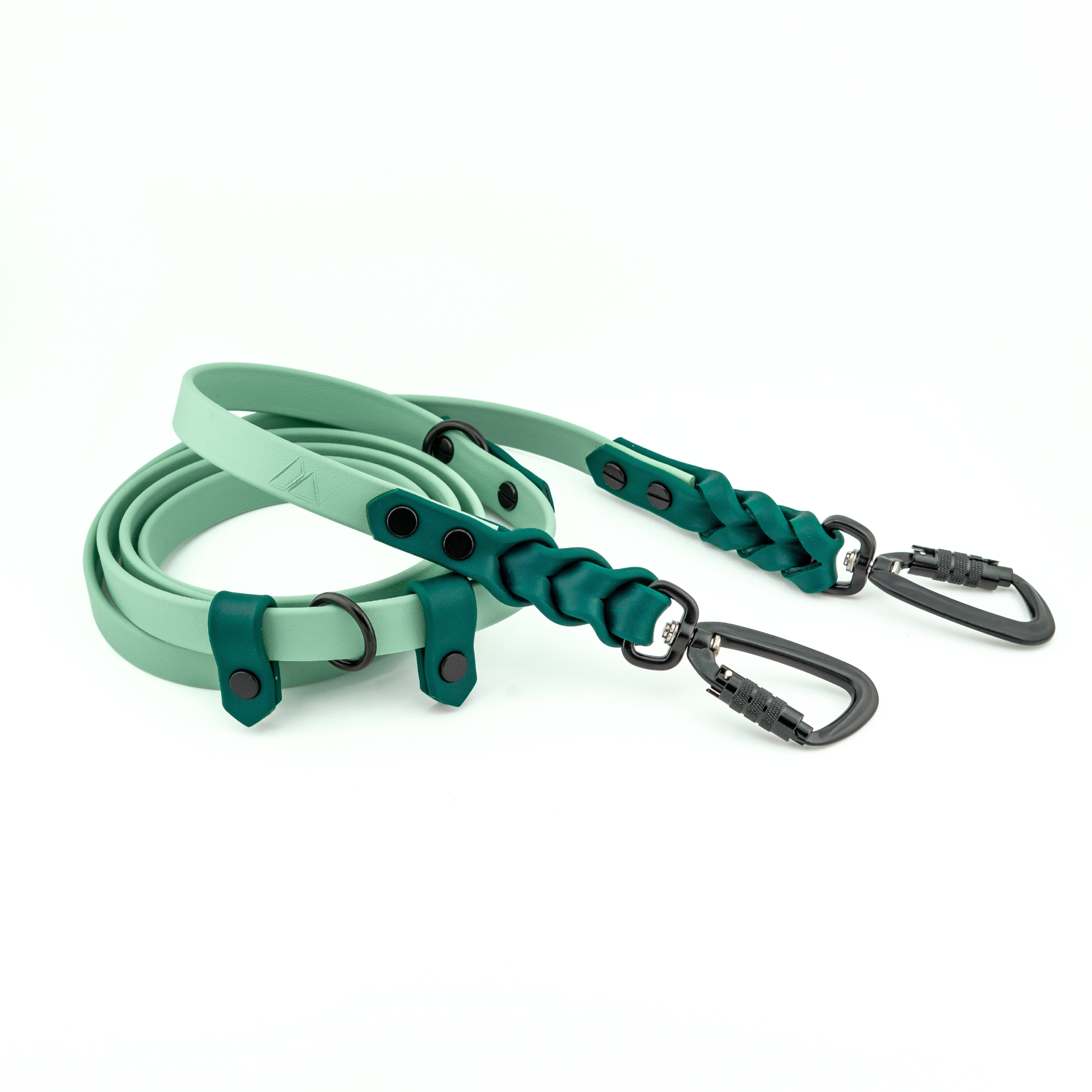
A dog leash safety connector is a short strap designed to create a secondary connection between two pieces of dog gear, such as a collar and harness. If one attachment point becomes disconnected or a dog slips out of one piece of equipment, the connector may help keep the second attachment point connected to the system.
Think of it as backup—not a replacement for properly fitted gear.
Safety connectors can be particularly useful when a handler wants redundancy for an escape-prone dog, a newly adopted dog, certain reactive-dog management setups, or another situation where relying on a single attachment point isn't ideal.
But a safety connector doesn't make a setup escape-proof, and simply adding more straps isn't automatically safer.
Here's how they work, when they make sense, and what to consider before adding one to your dog's gear.
How Does a Dog Leash Safety Connector Work?
A safety connector is relatively simple.
It's a short strap with attachment hardware at both ends. Rather than functioning as the dog's primary leash, it connects two pieces of equipment that would otherwise operate independently.
For example, imagine your dog's leash is attached to a harness.
A safety connector could run from that harness to the dog's collar. The harness remains the primary attachment point, while the collar becomes the secondary point.
If the harness were to become disconnected from the leash or the dog backed out of it, the connector may allow the collar to remain connected to the setup.
The same concept can work in other configurations depending on the equipment being used.
The important part is understanding the role:
Your leash is the primary restraint. The safety connector creates redundancy between attachment points.
It isn't meant to replace the leash.
Why Would You Use a Backup Attachment?
Most everyday dog walks happen with one leash attached to one collar or harness—and for many dogs and handlers, that's completely appropriate.
A second connection becomes useful when the consequences of equipment becoming disconnected are higher or when a dog's history makes the handler want additional redundancy.
Common examples can include:
- Newly adopted dogs whose behavior and handling tendencies aren't fully known yet
- Dogs with a history of backing out of harnesses
- Dogs that have slipped collars
- Dogs being transported through unfamiliar environments
- Reactive dogs that may make sudden movements around triggers
- Dogs being handled near busy roads or other higher-consequence environments
- Situations where a trainer or handler deliberately chooses a redundant setup
The goal isn't to create fear around normal dog walking.
It's simply recognizing that some dogs and some environments justify an additional layer of management.

Alt text: Dog safety connector attached between a collar and second attachment point
Safety Connector vs Double Leashing: What's the Difference?
These setups can look similar, but they're not necessarily the same.
A safety connector
A safety connector is a short secondary strap that connects pieces of equipment within the same restraint system.
The handler generally isn't holding it independently.
Two separate leashes
A double-leash setup uses two complete leashes, potentially attached to two different pieces of equipment.
That gives the handler two independent leash connections, but it also means managing more equipment.
A double-ended leash
A double-ended leash has attachment hardware at both ends and can sometimes be configured to connect to two points.
Its purpose and handling characteristics depend on the specific leash design.
None of these setups is universally better.
A safety connector is particularly useful when the goal is simple backup redundancy without requiring the handler to manage a second full-length leash.
When Does a Safety Connector Make the Most Sense?
For Dogs That Have Backed Out of Equipment Before
Some dogs become surprisingly good at reversing out of equipment when frightened, overstimulated, or determined to move in the opposite direction.
A properly fitted collar or harness should always come first.
But for a dog with a known history of slipping equipment, a secondary connection can provide another layer of management while you address fit and choose equipment appropriate for that dog.
For Newly Adopted or Foster Dogs
The first days and weeks with a new dog involve unknowns.
You may not yet know how the dog responds to traffic, wildlife, unfamiliar dogs, sudden noises, doorways, parking lots, or other environmental pressure.
A backup connection may be worth considering during that adjustment period, particularly if the dog's equipment history or escape tendencies are unknown.
For Some Reactive Dogs
Reactivity isn't an equipment problem, and a connector doesn't change the underlying behavior.
What it can do is support a management setup.
A reactive dog may make sudden, powerful movements when exposed to a trigger. Depending on the dog and equipment, a handler may prefer redundancy rather than having the entire setup depend on one clip and one attachment point.
If you're building a broader setup, our reactive-dog gear guide explains how leash length, attachment choices, rewards, and management equipment can fit together.
In Higher-Consequence Environments
Context matters.
Equipment becoming disconnected in a fenced training area isn't the same situation as equipment becoming disconnected beside a busy road.
A handler may choose additional redundancy for:
- Travel
- Parking lots
- Urban environments
- Veterinary visits
- Busy events
- Unfamiliar trails
- Temporary transitions between equipment
The dog doesn't necessarily have to be an escape artist for backup to make sense.
Sometimes the environment itself changes the risk calculation.
What a Safety Connector Cannot Do
This is just as important as understanding what it does.
It doesn't make gear escape-proof.
Dogs can damage equipment. Hardware can wear. Fit can change. Connections can be configured incorrectly.
A backup attachment reduces dependence on one point; it does not eliminate every possible failure.
It doesn't fix poorly fitted equipment.
If a harness is too loose or a collar doesn't fit correctly, address the fit.
Adding another strap shouldn't become an excuse to ignore the underlying problem.
It doesn't stop leash pulling.
A safety connector is not an anti-pulling device.
Training and handling still matter.
It doesn't fix reactivity.
It can support a reactive dog's management setup, but it doesn't modify the behavior by itself.
It doesn't replace equipment inspection.
Two worn attachment points aren't automatically better than one well-maintained one.
Clips, rings, webbing, stitching, fasteners, buckles, and connection points should still be checked regularly.
How Should a Dog Safety Connector Be Set Up?
The exact setup depends on the dog's equipment, but the principle is straightforward:
Choose a primary attachment point and use the connector to create a backup connection to a second appropriate attachment point.
For example:
Primary: leash → harness
Backup: harness/setup → safety connector → collar
The connector should not be configured in a way that interferes with normal movement, twists the equipment, creates unnecessary tension, or leaves excessive material dangling around the dog.
You also don't want the backup connection constantly bearing force if its purpose is simply redundancy.
Ideally, the primary equipment functions normally while the secondary connection remains available if needed.
Always consider the individual dog, fit, equipment design, and activity rather than copying a configuration simply because it worked for someone else's dog.
Should a Safety Connector Be Tight or Loose?
A backup connector generally needs enough length for the dog's primary equipment to function normally, but not so much excess length that the strap becomes cumbersome or easily tangled.
Too short can create unwanted tension between the two pieces of equipment.
Too long can add unnecessary movement and slack.
The appropriate length depends on:
- The distance between attachment points
- Dog size
- Collar position
- Harness design
- The dog's range of movement
- How the primary leash is attached
This is one reason a purpose-built dog leash Safety Connector is different from improvising a backup with an arbitrary piece of cord or oversized leash.
The goal is controlled redundancy without creating another handling problem.
What Should You Look for in a Dog Safety Connector?
A safety connector is small, but the same rules we use to evaluate larger pieces of dog gear still apply.
Appropriate hardware
Look at the hardware on both ends.
Those components are part of the connection, so their size, operation, condition, and compatibility with the intended attachment points matter.
Durable strap material
Because safety connectors may encounter rain, mud, wet grass, and regular outdoor use, easy-to-clean material is useful.
Bolder K9's safety and backup attachment gear uses BioThane® for exactly the kind of low-maintenance handling that makes sense in these setups.
Appropriate length
More material isn't necessarily better.
The connector needs to span the intended attachment points without interfering with the dog's equipment or creating excessive slack.
Compatible attachment points
Before buying anything, look at the actual equipment you're trying to connect.
Can the clips attach cleanly?
Are the rings large enough?
Will the connector interfere with buckles?
Does the configuration allow the equipment to sit correctly?
A good product can still be the wrong product for a particular setup.
Collar-to-Harness Safety Connections
Connecting a collar and harness is one of the most intuitive applications because it creates two separate wearable attachment points.
But that doesn't mean every collar-and-harness combination automatically creates a good setup.
Fit both pieces independently first.
A collar should be appropriate for the dog and its intended purpose. A harness should fit according to its manufacturer's instructions and shouldn't be assumed to be escape-resistant simply because it has multiple straps.
Then look at how the two pieces interact when connected.
The safety strap shouldn't distort the fit of either one.

Safety Connectors for Reactive Dogs
For a reactive dog, gear should support the handler's management and training plan rather than becoming the plan itself.
That's worth repeating.
A connector cannot stop a reaction or teach a dog how to respond differently to a trigger.
What redundancy can do is reduce dependence on a single attachment point during situations where sudden movement is possible.
For some teams, that extra layer makes sense. For others, a properly fitted single attachment and appropriate leash may be sufficient.
Our reactive dog gear guide covers the larger equipment picture, including leash selection and management considerations.
If you're dealing with significant reactivity, fear, aggression, or escape behavior, equipment choices should be considered alongside an appropriate training or behavior plan with qualified professional guidance when needed.
Don't Forget the Collar
If the collar is supposed to function as your backup point, it needs to be appropriately fitted and suited to that role.
A loose collar that a dog can easily reverse out of doesn't become reliable simply because you've attached a safety strap to it.
Likewise, different collar designs serve different purposes.
Before building a redundant setup, make sure you understand how your dog's collar fits and whether its design is appropriate for your intended use. Bolder K9's collar-selection resources can help you compare options based on fit and function rather than appearance alone.
Inspect the Entire System
A safety connector is only one link in the chain.
Before use, periodically inspect:
- The primary leash
- Leash clip
- Harness attachment point
- Collar
- Collar ring
- Safety connector
- Connector hardware
- Stitching or fasteners
- Webbing
- Any areas showing abrasion or unusual wear
Move clips through their full range of motion.
Check for debris around moving parts.
After saltwater, sand, heavy mud, or winter road salt, rinse equipment as appropriate and dry the hardware.
And if something looks structurally questionable, don't rely on the backup connector to compensate for it.
Replace damaged equipment.
Dog Leash Safety Connector FAQ
What is a dog leash safety connector?
A dog leash safety connector is a short strap used to create a secondary connection between two pieces of dog equipment. It can provide backup if the primary attachment point becomes disconnected or the dog slips one piece of equipment.
Does a safety connector replace a leash?
No. A safety connector is intended as a backup connection within the dog's equipment setup. The primary leash remains the main restraint.
Can I connect a dog's collar to its harness?
A short safety connector can be used to create a backup connection between compatible collar and harness attachment points. Both pieces should be fitted correctly and the connector shouldn't distort their fit or interfere with the dog's movement.
Are safety connectors good for reactive dogs?
They can be useful as part of some reactive-dog management setups because they provide redundancy between attachment points. They do not stop reactivity or replace training, management, appropriate equipment, or professional guidance when needed.
Does a safety connector make a dog escape-proof?
No. No connector should be treated as a guarantee against escape. Correct fit, appropriate equipment, handler awareness, maintenance, and training remain important.
Should every dog use a backup connector?
No. Many dogs are appropriately handled with one properly fitted collar or harness and one leash. Backup attachment makes the most sense when the dog's history, environment, equipment, or handling situation justifies additional redundancy.
Is a safety connector the same as using two leashes?
Not necessarily. A connector creates a short backup connection between pieces of equipment. Two-leash handling uses two full-length leash connections and requires the handler to manage both.
How often should I inspect a safety connector?
Give it a quick visual and functional check along with the rest of your dog's gear before use, and inspect it more closely after hard use, significant contamination, or whenever you notice wear or changes in the hardware.
The Bottom Line
A dog leash safety connector does one relatively simple job: it gives your setup a second connection instead of relying entirely on one attachment point.
For many dogs, that extra layer isn't necessary for everyday walking.
For an escape-prone dog, newly adopted dog, some reactive dogs, or situations where the consequences of equipment becoming disconnected are higher, redundancy may be a practical management choice.
Just don't confuse backup with a guarantee.
Start with properly fitted equipment. Choose attachment points intentionally. Inspect the whole system. Make sure the connector isn't interfering with movement or fit. And remember that equipment supports good handling—it doesn't replace it.
When an extra layer of redundancy makes sense for your dog, the right safety connector can provide it without forcing you to manage an entire second leash.