Choosing a leash for a large dog isn't just about heavy-duty labels. The right leash should fit your height and your dog's size. Consider your walking environment and preferred handling style.
A leash that's too short can feel restrictive. One that's too long can create excess slack. The wrong clip style can make the setup less suitable for your routine.
Bolder K9 builds customizable BioThane® dog leashes. This guide explains how to make those choices. We cover measuring, width, hardware, materials, and common activities.
1. Start with leash length—not your dog's weight
Many people assume every big dog needs the same length. This is a common mistake when choosing a leash.
In reality, the handler's height is an excellent starting point. A six-foot leash may feel comfortable to one person and unnecessarily long to another. Your dog's shoulder height, collar or harness attachment point, and preferred walking position also influence the amount of slack available.
The Bolder K9 foot-to-shoulder measuring method
To find a useful starting length for a standard leash:
- Stand upright in the shoes you normally wear while walking your dog.
- Measure vertically from the ground beside your foot to your shoulder.
- Use that measurement as your starting leash length.
- Adjust upward or downward based on your dog's attachment height, your hand position, and the environment.
This isn't a universal formula or a substitute for testing the actual fit. It's a practical way to start with your own body proportions rather than choosing a leash length arbitrarily.
If the leash leaves excessive slack dragging near your feet, consider sizing down. If your dog has little room to walk comfortably without constant tension, consider sizing up.
How common leash lengths compare
| Length | Generally useful for |
| 3–4 feet | Close handling, busy sidewalks, controlled transitions |
| 5–6 feet | Everyday neighborhood walks and general-purpose use |
| 7–8 feet | Quieter paths and situations where extra movement is appropriate |
| 10+ feet | Specific training exercises or open spaces, with careful line management |
Longer isn't automatically better. More length gives your dog additional movement, but it also gives the handler more line to manage.
Start with your foot-to-shoulder measurement. Refine it based on how the leash actually feels in use.
2. Choose a width that suits the dog and the handler
Leash width affects more than appearance. It changes how the material sits in your hand. It also balances the equipment with the hardware.
Bolder K9's featured large-dog leash designs use 3/4-inch Super Heavy BioThane®. This provides a substantial coated-webbing format for larger breeds.
We also offer leashes using 5/8-inch Beta BioThane®, which are generally better suited to small and medium dogs.
That doesn't mean every large dog requires the widest available leash, or that width alone establishes strength. A leash is a complete assembly, and its suitability depends on the webbing, connections, hardware, condition, and intended use.
Don't overlook total leash weight
A wider leash with a substantial metal clip may feel noticeably different from a lighter setup.
For a handler who prefers minimal hardware weight, this can matter during longer walks or repeated training sessions. A heavier clip isn't automatically the best choice simply because the dog is large.
Look for a combination of width and clip design. Ensure it feels manageable without compromising the complete leash.
Bolder K9's Professional Sewn Leash is one option worth considering for handlers who prefer a lighter standard-leash design. It uses bonded nylon stitching at its connections rather than Chicago screws.
3. Understand the leash clip before choosing a finish
The clip is one of the most important components of a leash, yet it's often selected based primarily on color.
For large dogs, start with the mechanism and intended application. Then consider whether you prefer silver, black, brass, or another available finish.
Bolder K9 offers several hardware options on its standard leashes, with different duty classifications.
| Clip option | Bolder K9 duty category | What to consider |
| Standard silver bolt snap | Light duty | Familiar spring-operated attachment |
| Standard black bolt snap | Light duty | Similar mechanism with black finish |
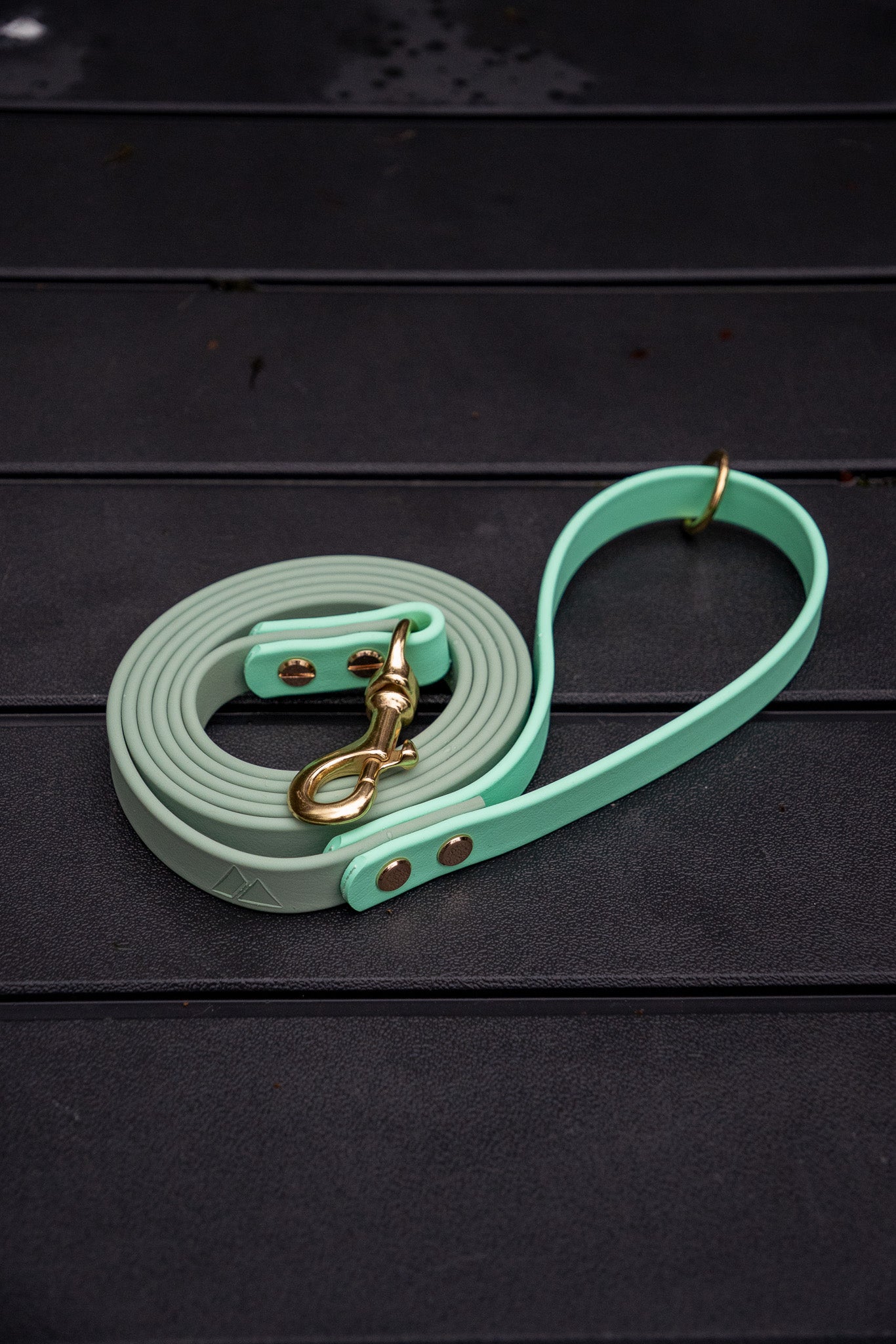
| Solid brass bolt snap | Medium/heavy duty | More substantial traditional bolt-snap option |
| Frog clip, black or silver | Heavy duty | Distinct attachment mechanism and handling feel |
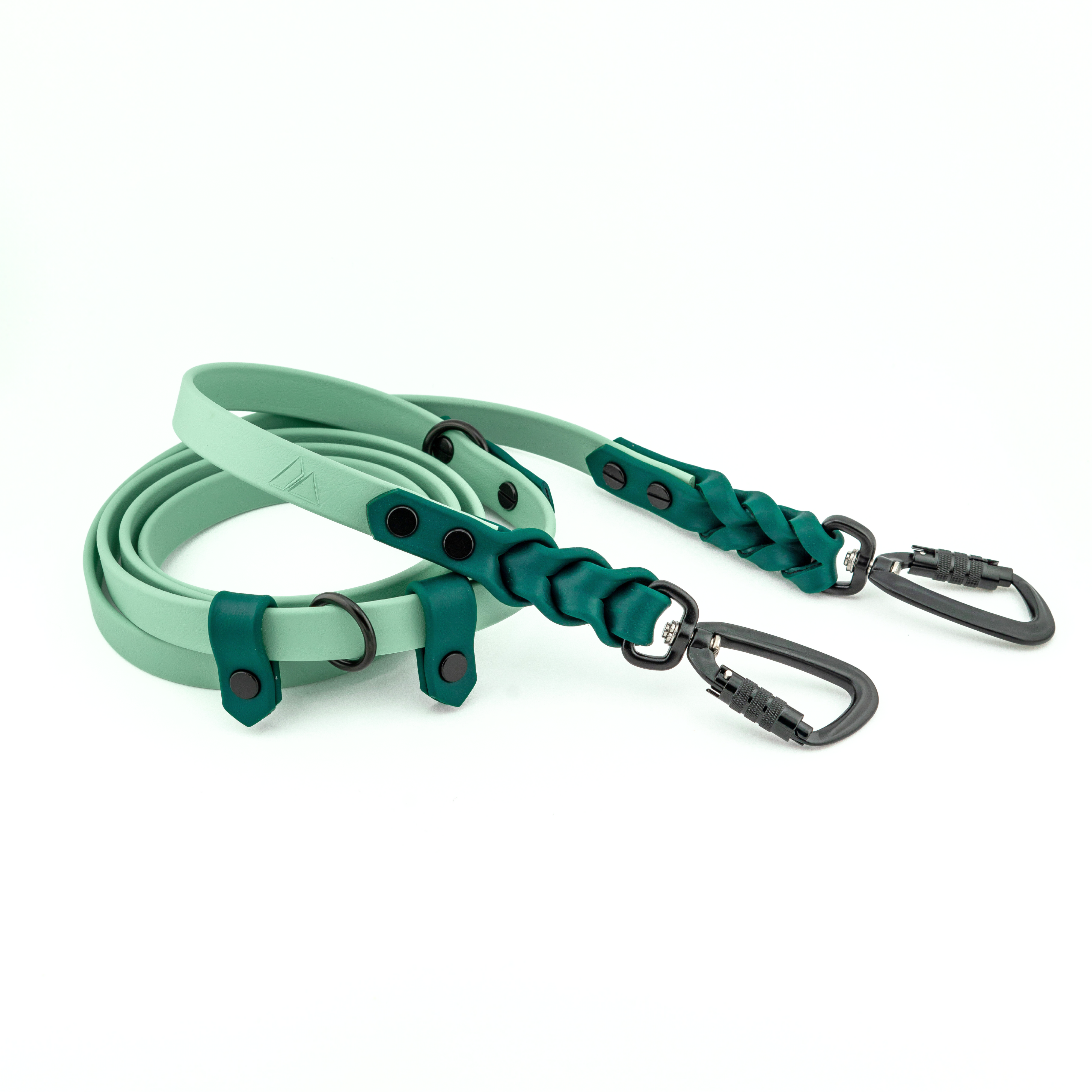
| Auto-locking carabiner, silver or black | Heavy duty | Locking gate that must close completely |
| Stainless steel bolt snap | Heavy duty | Substantial bolt-snap option |
| Rainbow solid brass bolt snap | Medium duty | Colorful finish with medium-duty classification |
These are Bolder K9's product categories, not published numerical breaking-strength ratings. The right hardware depends on your specific dog, the attachment ring, and the demands of the activity.
Bolt snaps: familiar and straightforward
Bolt snaps are popular because they're simple to understand. Pull back the sliding mechanism, attach the clip to the collar or harness ring, and release it.
The important detail is that not every bolt snap is constructed for the same application.
Our silver and black bolt snaps are light-duty. Solid brass and stainless steel options have different classifications.
For a strong dog, don't assume that every bolt snap offers the same suitability.
Frog clips: a different attachment experience
Frog clips have a distinctive opening and closing mechanism compared with traditional bolt snaps.
Bolder K9 offers frog clips in black and silver, categorized as heavy duty.
Some handlers prefer this style because of the way it operates. However, it's important to practice attaching and removing the clip before using it on an active dog.
Make sure it engages correctly with the collar or harness ring and that the connection isn't obstructed by nearby hardware.
Auto-locking carabiners: pay attention to the gate
Auto-locking carabiners are another heavy-duty option in the Bolder K9 lineup.
Their defining feature is the locking closure. That mechanism can be appealing to handlers who prefer a carabiner-style attachment, but it still requires proper operation.
Every time you connect the leash, verify that the gate has returned to its fully closed and locked position.
No clip should be treated as maintenance-free. Dirt, wear, and damage can interfere with moving parts over time.
4. BioThane®, nylon, or leather: which material works best?

A leash's material affects how it feels, how easily it cleans up, and how much care it requires.
Material choice matters for dogs walking in rain, mud, or dust. It makes a noticeable difference in convenience.
BioThane®: practical for changing conditions
BioThane® is a coated-webbing material with an easy-clean surface. Dirt can be wiped away easily. It requires less laundering than other materials.
That's particularly useful for dogs that spend a lot of time outdoors.
We use genuine BioThane® for walking, hiking, and training. Our 3/4-inch Super Heavy construction provides a substantial feel for larger breeds.
BioThane® isn't indestructible, though. It can still be damaged, and the leash's metal components and connection points require inspection.
Nylon: familiar and versatile
Nylon webbing is widely used in dog leashes. It comes in many widths, textures, and constructions, often at accessible prices.
Some woven nylon leashes can absorb moisture, hold dirt, or take longer to dry after muddy outings. Others are designed to reduce those issues.
Nylon can be a perfectly reasonable choice, but the construction and maintenance requirements matter.
Leather: traditional feel with additional care
Leather has a distinctive feel that many handlers appreciate. With use, it can soften and develop character.
However, leather generally needs more attention after repeated exposure to water and dirt. Cleaning, drying, and conditioning help maintain it.
For someone who wants a traditional material and doesn't mind that maintenance, leather may be appealing.
For someone who prioritizes quick cleanup after outdoor activities, BioThane® may be more convenient.
The best material is the one that fits your routine, not simply the one with the strongest marketing claims.
5. Match your leash to the activity
A large dog walking through a busy neighborhood presents different handling needs from one hiking on a quiet trail.
Rather than buying solely by breed or weight, think about where the leash will actually be used.
Everyday neighborhood walks
For daily walks, a standard handheld leash is a versatile starting point.
It lets you adjust your grip and gather excess length. This helps when navigating intersections, driveways, or other pedestrians.
Consider a customizable leash like the Atlas. You can select the length, clip style, and optional traffic handles.
Hiking and outdoor adventures
For hiking, consider the trail space and your dog's habits. Think about how often you need both hands.
A convertible hands-free leash can be convenient on appropriate terrain with a dog that walks predictably.
However, hands-free doesn't automatically mean better control. A dog that lunges or pulls suddenly can transfer force directly to the handler's body, potentially affecting balance.
On narrow or uneven trails, handheld management may be preferable.
If you choose a hands-free design, confirm that its adjustable length and body-worn configuration fit correctly. The foot-to-shoulder method used for standard leashes isn't the complete fitting method for hands-free equipment.
Training and structured walks
Training introduces another consideration: consistency.
A leash should let you manage slack and change direction comfortably. You should not fight the equipment while teaching behavior.
For loose-leash walking, a manageable standard leash is often a practical starting point.
For exercises requiring greater distance, a purpose-designed long line may be more appropriate than simply choosing an extra-long everyday leash.
Remember that no leash teaches loose-leash walking on its own. Equipment supports the training process; reinforcement, timing, and practice are what develop the behavior.
6. Consider how the leash is assembled
Two leashes can use similar-looking webbing but have different connection methods.
Some designs use Chicago screws to secure folded sections of webbing. Others use sewn connections.
Our Chicago-screw designs are measured, cut, and punched. We use permanent adhesive on the threads and sealer on cut ends.
Our Professional Sewn Leash uses bonded nylon stitching at the connections instead.
Neither method should be assumed superior in every situation without considering the complete design and relevant testing.
What's important is that the connections are appropriately constructed, inspected, and maintained.
Handmade leashes offer customization and individual attention. However, this does not always mean higher breaking strength than factory leashes.
7. Five mistakes to avoid when buying a large-dog leash
Choosing by breed alone. Two dogs of the same breed can have very different walking habits. Consider the individual dog, not just the breed label.
Assuming the longest leash is the most comfortable. Extra length can become tangled around legs or drag along the ground. Start with the foot-to-shoulder measurement and adjust from there.
Picking hardware entirely by appearance. A black finish or colorful clip doesn't tell you whether the mechanism is appropriate. Review the clip's duty category and intended use first.
Assuming thicker always means safer. Webbing width is only one component. Hardware, connections, condition, and handling also matter.
Do not overlook your own comfort. You may struggle to use a leash that is too heavy or awkward to grip.
8. Frequently asked questions
What length leash is best for a large dog?
Measure from the ground to your shoulder. Choose a standard length and adjust for your dog's height. Five- and six-foot leashes are common choices.
Is a 3/4-inch leash good for large dogs?
Bolder K9 uses 3/4-inch Super Heavy BioThane® in its featured large-dog leash designs. It offers a substantial coated-webbing format. Width alone, however, doesn't determine the strength or suitability of the complete leash.
Are frog clips better than bolt snaps?
Not universally. Frog clips and bolt snaps use different attachment mechanisms, and each comes in specific designs and duty categories. Choose based on the exact hardware, collar or harness compatibility, and how comfortably you can operate it.
Should I use a hands-free leash for a dog that pulls?
Use caution. Sudden pulling can transfer force to your torso and affect your balance. A standard handheld leash may be more appropriate when you need to change your grip or manage unpredictable movement. Address pulling through appropriate training rather than relying on leash configuration alone.
Is BioThane® better than nylon for large dogs?
BioThane® offers easy cleaning and is convenient for wet or muddy routines. Nylon offers different textures, weights, and price points. Neither material is automatically superior in every situation; the complete leash construction and your handling preferences matter.
How often should I inspect a dog leash?
Inspect your leash before each walk. Look for cuts, damaged connection points, or loose hardware. Replace damaged equipment immediately.
Find the right leash for large dog needs
Start with a length that fits your body. Select a manageable width and weight. Match the style to your activities.
Look beyond generic heavy-duty labels. Consider the actual configuration of the leash you are ordering.
Explore our Best Dog Leashes for Large Dogs buyer's guide to compare designs. You can also use the Bolder K9 Leash Finder to narrow your options.
The goal isn't to buy the biggest or most complicated leash available. It's to choose equipment that works comfortably and consistently for you and your dog.