Walking Your Dog With a Stroller: A Dog Trainer's Guide to Hands-Free Leashes
Walking your dog while pushing a stroller sounds simple enough. You've got two hands, a hands-free dog leash, and a stroller. What could go wrong?
Quite a bit, actually, if your dog doesn't have the right training foundation.
A hands-free dog leash can make stroller walks more convenient, but the leash itself isn't what makes the setup work. The training behind it does.
At Bolder K9, we're not just dog gear makers. We're also dog trainers. We are navigating life with our first baby. Teaching dogs to walk politely is nothing new to us. We also teach hands-free handling and working around distractions.
We've trained these skills before. Now we're putting them to use in a new chapter of our own lives.
Our approach is straightforward: teach loose-leash walking first, transition to a hands-free leash second, and introduce the stroller last.
Skipping those steps might seem convenient, but when there's a baby involved, convenience should never come before control.
Here's how we'd approach it.
Can You Safely Walk Your Dog While Pushing a Stroller?
Walking a dog alongside a stroller can be practical. It helps everyone get outside. The dog needs reliable leash manners. The handler must safely manage both.
But not every dog is ready for it.
A dog that pulls or lunges isn't ready for stroller walks. This includes chasing wildlife or struggling to stay engaged.
That doesn't mean the dog can never participate. It means there's training to work on before adding a stroller—and eventually a baby—to the equation.
Our biggest rule: Never attach your dog's leash directly to the stroller.
Even a well-trained dog can react unexpectedly. If the leash connects to the stroller, a pull could move or tip it. This puts your baby at risk.
A leash attached to the adult handler keeps the dog separate. It still requires training, balance, and active handling.
The goal isn't simply to have your hands available. It's to create a walking setup where you can manage your dog without compromising control of the stroller.
Step 1: Build a Solid Foundation of Loose-Leash Walking
Before hands-free leashes or strollers, a dog needs to walk on a loose leash.
And no, that doesn't mean your dog needs a competition-level heel.
For everyday stroller walks, we're looking for a few basic behaviors:
- Walking alongside the handler without constantly pulling.
- Maintaining a reasonably consistent position.
- Slowing down and stopping when the handler does.
- Changing direction without resistance or confusion.
- Responding to leash guidance and familiar verbal cues.
- Staying manageable around normal environmental distractions.
A dog doesn't need to stare at you for an entire walk. Sniffing and exploring are important parts of being a dog.
But there's a difference between giving your dog appropriate freedom and letting your dog decide where you're going.
Start with a regular leash
We generally recommend teaching these foundations with a traditional handheld leash before moving to hands-free handling.
A standard leash offers more direct feedback. It makes guiding the dog easier. You can adjust positioning and reinforce good behaviors.
Start in a relatively low-distraction environment.
Reward your dog for staying near you with a loose leash. Practice stopping, changing direction, and walking at different speeds.
If your dog pulls, avoid simply dragging them back into position. Instead, stop forward movement, reset, and reinforce the position or behavior you want before continuing.
The goal is to teach your dog that staying connected to the handler is what makes the walk work.
For more information about leash handling, check out our top leash-handling tips for dog owners.
Teach a consistent walking position
When pushing a stroller, your dog won't have the same freedom to move. They can't switch sides of your body as easily.
The stroller creates a physical obstacle, and you need your dog to understand where they're supposed to be.
We like teaching dogs to maintain a consistent side and stay generally alongside the handler rather than crossing in front.
That position may be on your left or right. The important part is that it works for your environment and keeps the dog clear of the stroller wheels.
Practice this long before introducing the stroller.
Don't rush the foundation
If your dog can't maintain a loose leash when you're walking normally, adding a stroller won't make things easier.
And a hands-free leash won't fix pulling.
Equipment can support good handling, but it doesn't replace training.
Step 2: Transition From a Traditional Leash to a Hands-Free Leash
Once your dog has reliable loose-leash manners, it's time to introduce hands-free handling.
This is where a lot of people get ahead of themselves.
People buy hands-free leashes for freedom. They clip it around their waist or body. Then they head out with a dog that still pulls.
The result is often a dog dragging the handler around by their center of mass.
That's not what hands-free equipment is designed to accomplish.
A properly used hands-free leash adds convenience to walks. It works best when your dog understands leash pressure. They should also know positioning and walking with you.
Start without the stroller
Your first hands-free sessions should look a lot like your regular walks.
Use a familiar environment, keep distractions manageable, and practice the same behaviors you've already established:
- Starting and stopping together.
- Maintaining position.
- Changing direction.
- Walking without sustained leash tension.
- Returning attention to the handler when needed.
Pay attention to how the leash feels when your dog changes direction.
A handheld leash lets you make small adjustments with your arm. A hands-free leash transfers more of that force through your body.
That difference matters, especially with larger, stronger, or high-drive dogs.
Waist leash or crossbody leash: Which is better?
Both can work, but the best choice depends on the dog, the handler, and the leash design.
Waist-worn leashes attach around the handler's waist and may offer a comfortable setup for steady walking. However, a sudden pull can affect your hips and balance.
Crossbody leashes distribute the leash across the torso and may be comfortable for everyday walking, depending on fit and design. A strong pull can still rotate or destabilize the handler.
Neither setup automatically gives you more control than a traditional leash.
For stroller walking, we prioritize a secure and comfortable fit. Leash length must be appropriate. You need to quickly take the leash in hand when necessary.
We also want the leash positioned so it doesn't interfere with our arms or the stroller handle.
Practice taking control of the leash
Hands-free shouldn't mean hands-off.
You should be comfortable reaching down, gathering leash slack, and transitioning to active leash handling when needed.
Practice doing this before introducing the stroller.
If your dog spots a distraction, you need to reach the leash easily. The first time shouldn't be while also managing a stroller.
A good hands-free system gives you flexibility. It doesn't eliminate the need to handle your dog.

Step 3: Introduce the Stroller Without the Baby
Once your dog is comfortable walking on a hands-free leash, it's time to bring the stroller into the picture.
Start with an empty stroller.
Do not introduce your dog to a large, moving object. This should not happen while your baby is inside it.
Even dogs that are comfortable around bicycles, wagons, or other equipment may need time to adjust to a stroller.
It moves differently, takes up more space, and changes how the handler walks.
Let your dog get comfortable with the stroller
Begin by allowing your dog to observe the stroller while it's stationary.
Reward calm behavior and give your dog space to investigate if they want to.
There's no need to force an interaction.
Then begin moving the stroller slowly while another adult handles your dog.
This lets you introduce the motion without immediately asking one person to manage everything.
Practice walking beside the empty stroller
When your dog is comfortable, begin short walking sessions with the stroller.
If possible, have another adult present during early training. One person can focus on the dog. The other can handle the stroller.
Practice:
- Walking in a straight line.
- Stopping and waiting.
- Making wide turns.
- Changing walking speed.
- Navigating corners and doorways.
- Maintaining position when the stroller changes direction.
Start somewhere quiet and predictable.
A driveway, wide path, or quiet neighborhood sidewalk can be useful depending on your dog's training level.
The goal is to make the stroller just another normal part of the walking environment.
Teach your dog to stay clear of the wheels
This is one of the most important differences between regular leash walking and stroller walking.
A dog that cuts across your path can create a tripping hazard on a normal walk.
With a stroller, that same behavior can put the dog directly in front of a wheel.
We want dogs to understand that their walking position is alongside the handler, not directly in front of the stroller.
Practice turns carefully and reward your dog for staying in the correct position.
Never intentionally bump your dog with the stroller to teach them to move. Use clear guidance, appropriate spacing, and reinforcement instead.
The stroller should be predictable, not something your dog has to dodge.
Step 4: Choose the Right Hands-Free Dog Leash for Stroller Walking
Not all hands-free leashes are equally practical for walking with a stroller.
A leash that works well on a hiking trail might be unnecessarily long for a narrow sidewalk.
A leash comfortable for a small, steady dog may not suit a large, powerful breed.
When choosing a leash, we focus on three things: usable length, adjustability, and handling.
What leash length is best for walking with a stroller?
For many trained dogs, a short working distance is useful. This means 2-4 feet between handler and dog. It's a good starting point for stroller walks. Bolder K9 hands-free leashes are measured from end to end. When choosing the right leash length, you'll need to account for both the distance between you and your dog and the length needed to wrap around your body, depending on where and how you plan to secure the leash. We typically recommend our 6.5 to 8 foot options for most people looking to walk hands-free.
That's the usable leash length, not necessarily the total advertised length of the leash.
A hands-free leash needs additional length to wrap around your waist or across your body.
A six-foot leash won't provide six feet of freedom. Part of its length is worn by the handler.
The ideal setup depends on your body size, attachment position, leash configuration, dog's height, and walking environment.
| Leash setup | Practical considerations |
| Short working length | Keeps the dog closer and reduces opportunities to cross in front of the stroller, but requires good positioning. |
| Moderate working length | Allows some additional movement while remaining manageable in open areas. |
| Long working length | Can create excess slack and increase the risk of tangling around stroller wheels or other obstacles. |
| Adjustable hands-free leash | Allows the handler to tailor the setup to their body, dog, and environment. |
We prefer enough leash for comfortable walking without tension. But it shouldn't be so long that the dog crosses the stroller's path.
If you constantly gather loose leash, your setup needs adjustment. Too much slack gets caught in the wheels.
Why adjustability matters
A hands-free leash should fit the person wearing it, not just the dog.
Someone wearing a leash crossbody will use a different amount of material than someone wearing it around their waist.
The same leash may also fit two handlers differently.
That's why we like adjustable hands-free designs.
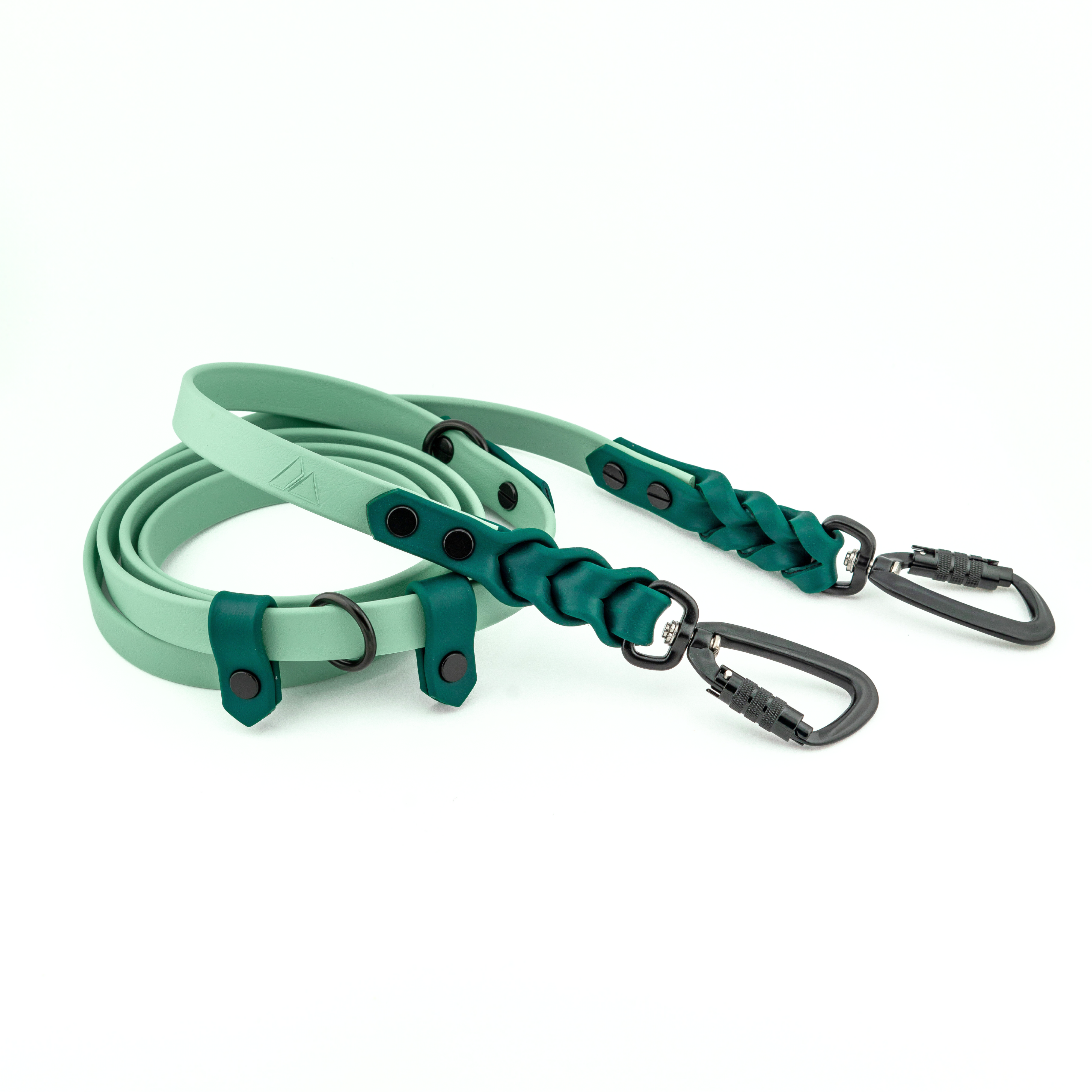
Our Trailblazer Hands-Free BioThane® Leash is one option for trained dogs and handlers looking for a durable hands-free setup.
The important part is choosing a configuration that provides an appropriate working length and allows you to maintain control.
What about leash material?
As gear makers, we're particular about materials because we know how much abuse everyday dog equipment can take.
For busy parents, we also appreciate gear that's easy to maintain.
Genuine BioThane® is practical and water-resistant. It's easy to wipe clean. It doesn't absorb moisture like woven materials.
Rain, muddy paws, wet sidewalks, and the occasional leash dragged through something unpleasant are all part of dog ownership.
Having equipment that doesn't require a complicated cleaning routine is a nice bonus when you're already managing a baby.
But material choice is secondary to fit, appropriate hardware, leash handling, and training.
Can You Attach a Dog Leash Directly to a Stroller?
We generally do not recommend attaching a dog leash directly to a stroller, especially with a baby inside.
This includes clipping a leash to the handlebar. Do not wrap it around the frame. Avoid using a fixed tether attached to the stroller.
Here's why.
Even a reliable dog can react unexpectedly.
A squirrel runs across the sidewalk. Another dog rushes toward you. A loud noise startles your dog.
If the leash attaches directly to the stroller, force transfers to it. The handler loses control of that force.
Sudden force could move or tip the stroller. This depends on the dog's size, speed, and direction. The stroller's design also plays a role.
That's a risk we don't think is worth taking.
Is a hands-free leash safer?
A hands-free leash worn by the handler avoids directly tethering the dog to the stroller, but it isn't automatically safe.
If your dog lunges while attached to your waist or torso, that force can pull you off balance.
And losing your balance while pushing a stroller creates its own risks.
That's why the training foundation matters so much.
We don't recommend using a hands-free leash as a shortcut for managing a dog that pulls or reacts unpredictably.
If your dog isn't ready, use separate walks and continue training without the baby present.
The right equipment should support your handling skills, not compensate for missing ones.

Step 5: Your First Walk With the Baby
Once your dog is reliably walking alongside the empty stroller, you can begin planning your first walk with the baby.
We recommend keeping the first few outings simple.
Choose a familiar route with plenty of room, limited traffic, and minimal distractions.
Avoid crowded sidewalks, busy parks, and environments where you know your dog struggles.
If another adult can join you for the first few walks, even better.
One person can focus on the stroller and baby while the other manages the dog.
Before leaving the house
Take a minute to check your setup.
Make sure your dog's collar or harness fits well. Leash hardware should be secure. You need an appropriate amount of working length.
Check that the leash isn't hanging near the stroller wheels or wrapped around the handle.
Confirm your stroller is configured for your baby's age and size. Follow manufacturer instructions for restraints, brakes, and safe use.
Have your dog wait while you prepare to leave.
A calm start makes the rest of the walk easier.
During the walk
Keep your dog in their trained walking position and pay attention to the environment.
Watch for approaching dogs, bicycles, narrow sidewalks, and anything that might cause your dog to change direction unexpectedly.
Give yourself room to move.
Don't hesitate to stop, create distance, or change your route if a situation becomes difficult.
And if your dog is having an off day, there's nothing wrong with heading home.
Not every walk needs to become a training challenge.
Keep the first walks short
Your first outing doesn't need to be a three-mile neighborhood adventure.
Start with a manageable distance, evaluate how the setup feels, and gradually increase the duration as everyone becomes comfortable.
Remember, the baby adds another variable.
You may need to stop unexpectedly, adjust the stroller, or return home earlier than planned.
Having a dog that can calmly stop and wait makes those moments much easier.
What If Your Dog Pulls or Is Reactive?
This is where we'd encourage people to be realistic about their dog's current abilities.
A dog needing an occasional reminder is different. It's not like a dog that regularly lunges. This includes lunging at other dogs, wildlife, or vehicles.
If your dog is reactive, a stroller walk may introduce more risk than you're comfortable managing.
And that's okay.
The answer isn't necessarily to buy a stronger leash or add more equipment.
It's to address the behavior, improve management, and decide whether walking with the stroller is appropriate for your individual dog.
Our guide to reactive dog gear and what you actually need discusses equipment. It fits into a broader management and training plan.
For dogs with significant reactivity, work with a trainer. Do this before attempting walks with your baby. This also applies to dogs with a history of lunging.
Sometimes the best choice is to walk the dog separately.
There's no rule that says your dog and baby have to go everywhere together.
Can You Walk Two Dogs With a Stroller?
Potentially, but it's a more complicated setup.
Even two individually well-trained dogs may behave differently when walking together.
They can cross paths, become tangled, respond to each other's distractions, or create competing leash pressure.
Adding a stroller reduces the handler's ability to manage those situations.
We would want both dogs to have excellent individual leash manners before even considering walking them together with a stroller.
We'd also want to practice the two-dog setup extensively without the baby.
For many households, separate walks are practical. Another adult can also handle one of the dogs.
There's nothing wrong with making that decision.
Common Mistakes When Walking a Dog With a Stroller
A few mistakes are worth avoiding from the beginning.
1. Starting with the stroller before teaching leash manners. Your dog should understand the walking expectations before you add another obstacle.
2. Assuming a hands-free leash stops pulling. It doesn't. It simply changes where the pulling force goes.
3. Choosing a leash that's too long. Excess slack can tangle in stroller wheels. It can also wrap around your legs. Your dog might cross in front unexpectedly.
4. Attaching the leash directly to the stroller. A sudden pull can compromise stroller stability and put your baby at risk.
5. Going somewhere too distracting too soon. Start with familiar, manageable environments before increasing the difficulty.
6. Expecting perfection immediately. Even well-trained dogs may need time to adjust to walking beside a stroller.
7. Ignoring your own handling limitations. If you're struggling to manage the dog and stroller together, change the setup rather than forcing the walk.
Frequently Asked Questions
What is the best hands-free dog leash for walking with a stroller?
For a dog with reliable loose-leash manners, an appropriately fitted, adjustable hands-free leash can be a practical choice. Look for comfortable body positioning, suitable hardware, and enough control to keep your dog clear of the stroller wheels.
A traditional handheld leash may be preferable. Use it if your dog needs frequent guidance. It's also good if you're not comfortable hands-free.
Should I use a waist leash or crossbody leash with a stroller?
Either may work for a trained dog. It depends on your body size. Leash design and pulling force distribution matter.
The best option is comfortable to wear. It lets you maintain balance. You must have active control of both dog and stroller.
How long should a hands-free leash be for stroller walking?
Focus on the working length between your body and your dog rather than the total advertised length.
A short working distance of 2-4 feet can be useful. This is for a trained dog, but it's not a universal rule. Correct length depends on your dog's size and walking position. Leash configuration and environment also matter.
Can I attach my dog's leash to the stroller handle?
We don't recommend it. A sudden pull could move or tip the stroller, creating a serious risk for the baby.
Keep the dog physically separate from the stroller and under the control of an adult handler.
Can I use a retractable leash while pushing a stroller?
We generally wouldn't recommend it.
Retractable leashes let the dog move too far. They create more chances for tangling. This includes stroller wheels, pedestrians, or obstacles.
A fixed-length or appropriately adjusted leash offers more predictable positioning.
When should I start training my dog to walk with a stroller?
Ideally, before the baby arrives.
Begin with loose-leash walking, introduce hands-free handling once those skills are reliable, and then practice around an empty stroller.
How long the process takes depends on your dog's existing training and comfort level.
Can a reactive dog walk beside a stroller?
Some dogs may eventually be able to manage. It depends on their reactivity's nature and severity. Training progress and the environment are also factors.
A dog that regularly lunges should not be walked with a stroller. This applies if it's difficult to control. Address the risks appropriately first.
Does my dog need to walk in a perfect heel?
No.
For everyday stroller walks, the goal is predictable positioning, a loose leash, and responsiveness to the handler.
Your dog can still enjoy the walk without maintaining a formal competition heel.
Final Thoughts: Training First, Gear Second, Stroller Third
Having a baby changes routines. But your dog doesn't have to stop being part of adventures.
A walk around the neighborhood can still be an opportunity for exercise, enrichment, and spending time together.
The key is setting everyone up for success.
As dog trainers and gear makers, we believe in good equipment. It should make well-trained behaviors easier to manage. It shouldn't be a substitute for those behaviors.
That's why we approach stroller walking in three stages:
Loose-leash walking. Hands-free leash handling. Stroller introduction.
Build the foundation, practice each transition, and don't rush to add the baby until you can confidently manage the setup.
If you're ready to explore hands-free leash options, take a look at our Bolder K9 hands-free leash collection.
Choose the equipment that fits your dog, your handling style, and the way you actually walk.
Because the best leash isn't the one that promises to solve everything.
It's the one that works with the training you've already put in.