Sewn vs. Riveted Dog Leashes: What’s the Difference?
The short answer: Sewn and mechanically fastened dog leashes can both be durable when they're made with appropriate materials and constructed correctly. The bigger difference is how the folded webbing around the leash hardware is secured. Sewn leashes use rows of heavy-duty stitching, while many leashes use rivets or threaded fasteners. At Bolder K9, we don't use traditional rivets on our standard BioThane® leashes—we use multiple Chicago screws. Neither construction method is automatically the better choice for every dog or handler.
When people compare dog leashes, most of the attention goes to the obvious stuff.
BioThane® or nylon? Six feet or four? Bolt snap or carabiner? Standard or hands-free?
But there's another detail sitting right in front of you that doesn't get nearly as much attention: how the leash is actually put together.
Look where the leash material folds around the clip or forms the handle. Something has to hold those layers together.
Depending on the leash, that might be stitching, rivets, screws, braiding, or another construction method.
At Bolder K9, we've built leashes using different methods because we don't believe every leash has to be constructed exactly the same way. Our Professional line includes sewn construction, while most of our other BioThane® leashes use Chicago screws.
So, what's actually different—and should you care?
First: Rivets and Chicago Screws Aren't the Same Thing
Let's clear this up before going any further.
People often use terms like “riveted leash” to describe any leash with visible round metal fasteners. But not every metal fastener is a rivet.
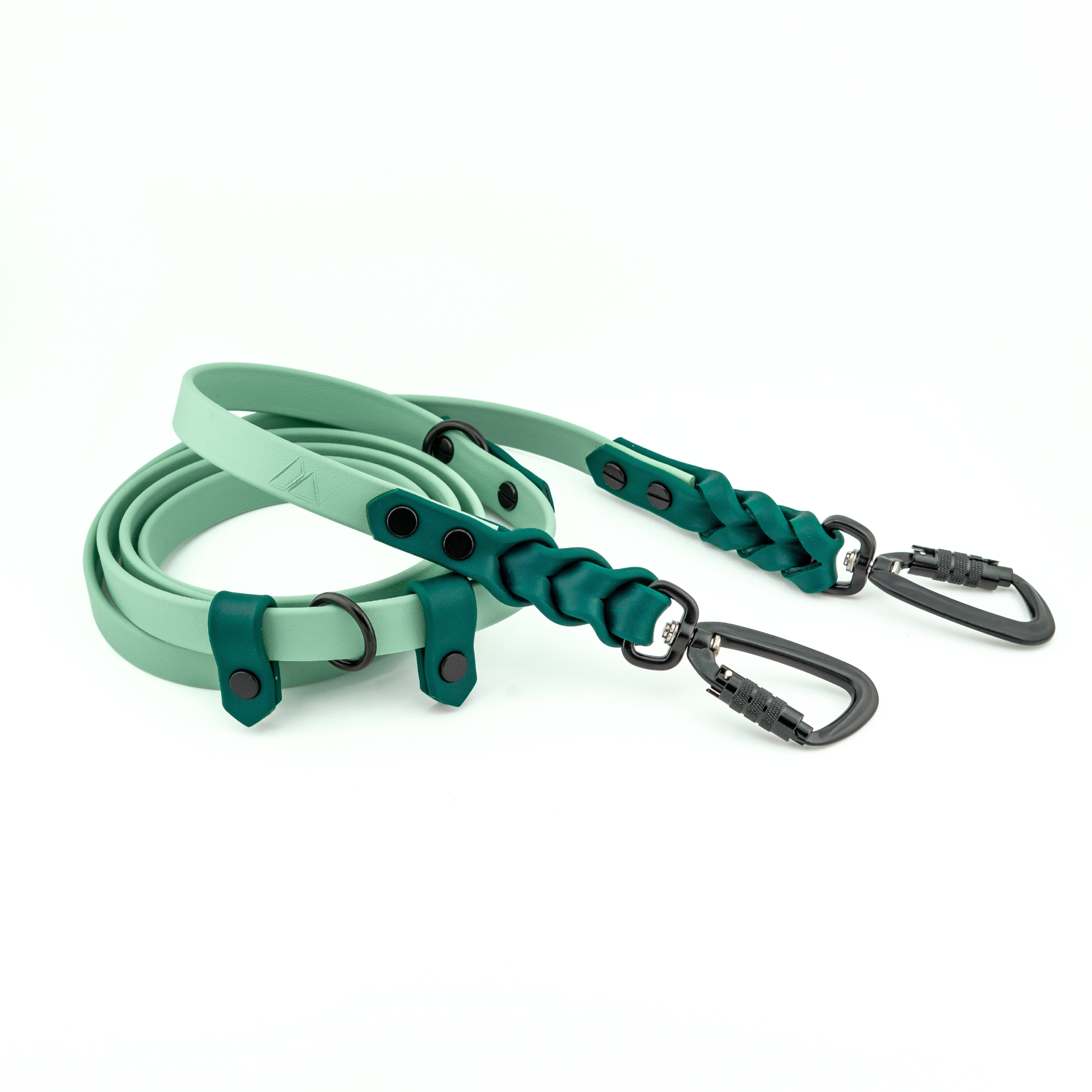
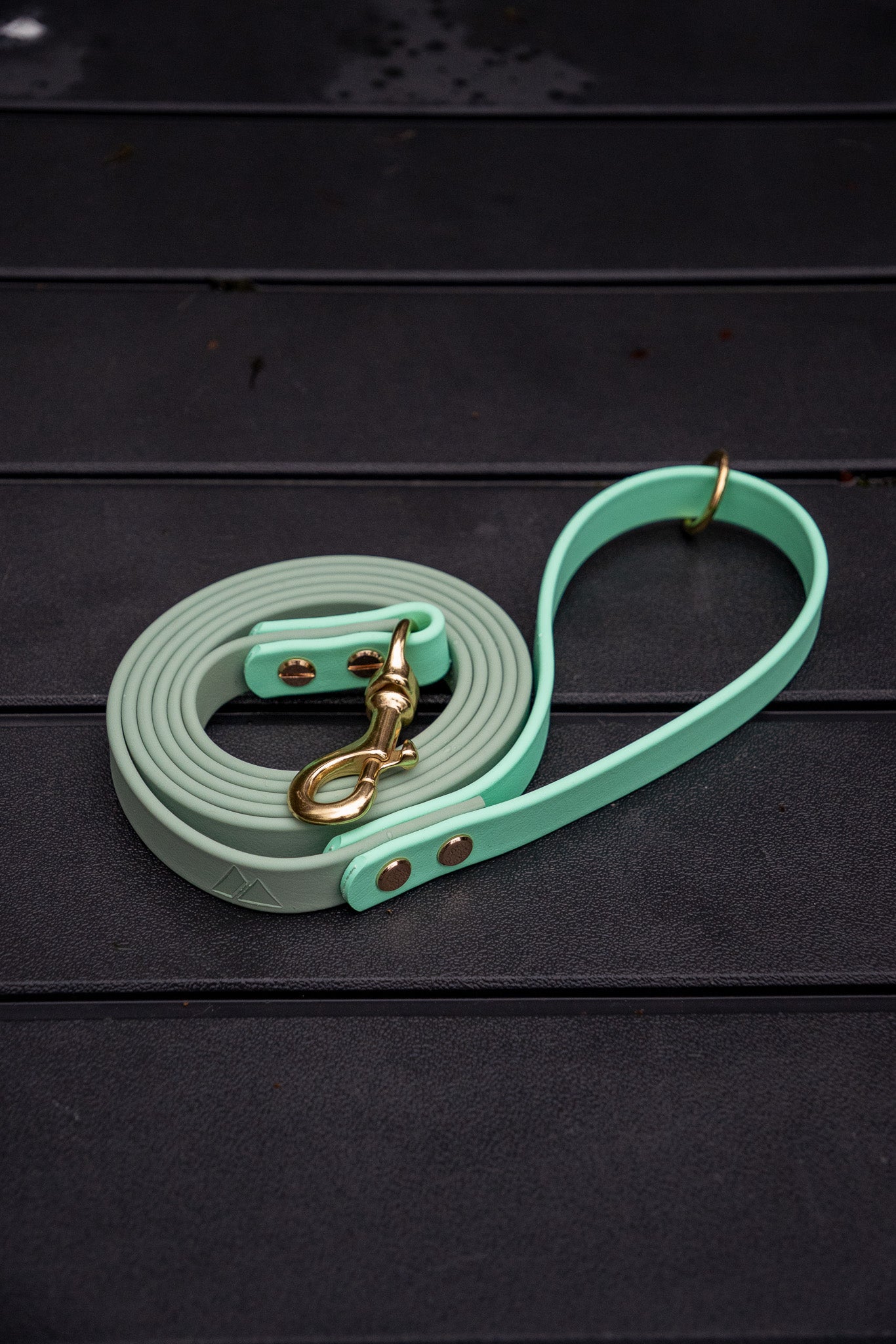
Bolder K9's standard BioThane® leash construction uses Chicago screws, not traditional rivets.
A rivet is a permanent mechanical fastener that is installed by deforming part of the rivet to secure materials together.
A Chicago screw—also called a screw post or binding post—is different. It consists of male and female threaded components that screw together through the material.
From the outside, the finished products can look somewhat similar.
Mechanically, they're not the same thing.
That distinction matters when you're comparing leash construction online, because “sewn vs. riveted” isn't always the comparison you're actually looking at.
What Is a Sewn Dog Leash?
A sewn leash uses stitching to secure folded sections of leash material around attachment hardware and at other connection points.
But “sewn” by itself doesn't tell you much about quality.
The thread matters.
The stitch pattern matters.
The number of rows matters.
The material being sewn matters.
And protecting the stitching from abrasion can matter just as much as the stitching itself.
Our Professional Sewn BioThane® Dog Leash is a good example of how we approach this style of construction.
It uses 3/4-inch Super Heavy BioThane® with a triple-row stitch pattern at the clip and handle. We use Tex 132 bonded polyester thread, and the stitched areas are protected with PVC wrap to help reduce abrasion and wear.
That's very different from simply running a couple of stitches through webbing and calling it a sewn leash.
Expert observation: pay attention to exposed thread
This is one of the less glamorous details that matters in actual use.
When we're evaluating a sewn connection, we're not only thinking about whether the thread can handle load. We're also thinking about what happens to that thread over time.
A leash gets dropped.
It gets dragged.
It gets wet.
It rubs against equipment.
It ends up in dirt, gravel, mud, vehicles, training fields, and gear bags.
That's why our sewn construction protects the stitched connection with PVC wrap. The goal isn't simply to create a strong stitch pattern; it's to protect a potential wear point from the environment the leash is actually going to encounter.
Best for: Handlers who prefer a streamlined, professional construction; repeated training use; working-dog applications; and customers who specifically prefer sewn connection points.
Not ideal for: Someone choosing solely because they've heard that “sewn is always stronger.” Construction quality involves more than whether thread is present.
What Is a Chicago-Screw Dog Leash?
A Chicago screw uses two threaded metal components that meet through holes in the overlapping leash material.
On many Bolder K9 leash designs, we use multiple Chicago screws at connection points rather than a single fastener.
Our Element BioThane® Dog Leash, for example, uses three Chicago screws on each side of its construction.
That gives us a clean, compact mechanical connection without relying on stitching.
And this is important:
A leash having visible screws does not automatically make it a cheaper or less serious construction method.
We've used Chicago-screw construction for years on gear intended for real everyday use.
Expert observation: look at the whole connection, not one screw
Customers sometimes focus on one component in isolation.
Is the screw strong?
Is the thread strong?
Is the BioThane® strong?
Those aren't bad questions, but a leash doesn't function as isolated pieces.
The connection includes the webbing, amount of overlap, number and placement of fasteners, leash hardware, construction method, and workmanship.
After years of making BioThane® gear, we've learned to pay particular attention to connection points and hardware, because genuine BioThane® itself is rarely the only part of the leash worth evaluating.
Best for: Everyday leashes, minimalist construction, handlers who like a clean mechanical connection, and designs where Chicago screws make sense for the overall build.
Not ideal for: Someone who specifically wants a thread-based, sewn finish or prefers not to have exposed mechanical fasteners.

Sewn vs. Chicago-Screw Dog Leashes: Quick Comparison
| Feature | Sewn Construction | Chicago-Screw Construction |
| How the connection is secured | Heavy-duty thread and stitch pattern | Threaded male/female metal fasteners |
| Visible construction | Stitching; may include protective covering | Round metal screw heads |
| Bolder K9 example | Professional Sewn BioThane® Dog Leash | Element and most other Bolder K9 BioThane® leashes |
| What matters most | Thread, stitch pattern, protection and workmanship | Number, placement, material, installation and workmanship |
| Overall appearance | Streamlined professional finish | Clean mechanical finish |
| Best for | Handlers specifically wanting reinforced sewn construction | Everyday and specialty designs where mechanical fastening fits the build |
| Automatically stronger? | No | No |
That's really the point of this entire comparison:
Construction quality matters more than the label.
We wouldn't choose a leash simply because somebody told us it was sewn.
We also wouldn't reject a leash simply because we could see metal fasteners.
We'd want to know how it was made.
Is a Sewn Dog Leash Stronger Than a Screwed or Riveted Leash?
Not automatically.
There are too many variables involved to make “sewn is stronger” or “screws are stronger” a useful universal rule.
A poorly executed sewn connection isn't made excellent simply because it contains thread.
Likewise, one poorly installed fastener shouldn't be treated as equivalent to a deliberately engineered connection using multiple fasteners.
The material, hardware, fastener or thread selection, connection design, workmanship, wear, and intended use all contribute to the finished leash.
That's why we offer both construction methods.
If we believed Chicago-screw construction was inherently inadequate, we wouldn't use it across most of our leash lineup.
If we thought sewn construction offered no advantages, we wouldn't have developed our Professional Sewn products.
They're two ways of solving the same fundamental problem: creating a dependable connection between the leash material and its hardware.
Why We Use Sewn Construction on Our Professional Leashes
There are applications where we specifically want a sewn build.
The Professional Sewn Dog Leash is intended for handlers who want a straightforward, reinforced leash built around repeated use. Its triple-row stitching and protected connection points give the leash a distinctly professional construction.
The same thinking becomes even more relevant when we move from a standard leash to a long working line.
Our Professional BioThane® Tracking Line is built for tracking, trailing, scent work, recall training, and other working applications.
That line uses 3/4-inch Super Heavy BioThane®, bonded thread at its connections, and protective PVC wrap over the stitching.
It is also intentionally available without a traditional handle because when a long line is moving through tall grass, brush, roots, and uneven terrain, reducing potential snag points can be useful.
That's an important example of how we think about leash design:
The construction method should serve the job—not become the job.
We're not sewing a tracking line just so we can put “sewn” in its product name.
The material, stitching, hardware, connection protection, length, and handle configuration all have to make sense together.
Why We Still Use Chicago Screws on Most of Our Leashes
Because they work well for the designs we're building.
Sometimes simple really is the right answer.
A leash like the Element doesn't need to become more complicated simply to look more “professional.” Multiple Chicago screws give us a clean, secure connection while maintaining the minimalist construction that makes the Element what it is.
Other leash designs may have adjustment points, different hardware configurations, braiding, multiple colors, or hands-free functionality.
The fastener is one component within that larger design.
This is also why comparing leashes based on one construction feature can get misleading.
A customer may ask:
“Should I get the sewn one or the one with screws?”
We'd rather ask:
What are you doing with the leash?
Which Construction Should You Choose?
For an everyday walk, training session, hike, or similar general use, you don't necessarily need to make your buying decision based on stitching versus Chicago screws.
Look at the whole leash.
Consider:
- How you'll use it
- Length
- Width and weight
- Clip style
- Handle design
- Adjustability
- Overall bulk
- Construction
- Your dog's size and handling needs
- Your own preferences in hand
If you're a professional trainer, working-dog handler, or simply prefer the construction and finish of a sewn leash, the Professional Sewn is the obvious Bolder K9 option to consider.
If you want a simpler everyday leash, a Chicago-screw design such as the Element may make more sense.
If you need a long line specifically for tracking or demanding working applications, the Professional Tracking Line gives you a very different tool from either standard leash.
None of those decisions require declaring one construction method universally superior.
They require matching the tool to the job.
What About Leashes for Strong Dogs?
This is where we'd be especially careful about oversimplifying construction.
A powerful dog doesn't magically make every sewn leash a better choice than every mechanically fastened leash.
When you're choosing equipment for a strong dog, evaluate the leash as a complete system.
Look at the webbing.
Look at the clip.
Look at the connection.
Look at the handle.
Look at the length.
And look at how you're actually going to use it.
Our guide to choosing a leash for strong dogs goes deeper into hardware and whole-leash construction for exactly this reason.
A stronger or heavier leash also doesn't train a dog not to pull, lunge, or surge. Equipment can support handling, but it doesn't replace training, management, or handler skill.

What We Look at When Evaluating Leash Construction
After years of making BioThane® gear, we don't judge a leash by one feature.
We look at how everything works together.
Connection points: How is the folded material secured, and how much stress will that area repeatedly experience?
Hardware: The webbing can be excellent and the construction can be excellent, but the clip still matters.
Wear protection: Are vulnerable components unnecessarily exposed to abrasion?
Material: Is the webbing appropriate for the intended use and hardware?
Complexity: Is every component there for a reason, or has unnecessary hardware been added simply to make the leash appear more substantial?
Intended use: A six-foot everyday leash and a professional tracking line have different jobs. Their construction should reflect that.
That's a much more useful way to evaluate dog gear than searching for one magic feature.
The Bottom Line: Sewn Isn't Automatically Better—and Neither Are Screws
If you're comparing a sewn dog leash with a riveted or screwed leash, don't stop at the construction label.
Look closer.
A well-made sewn connection can be an excellent choice. A properly constructed leash using multiple quality Chicago screws can be an excellent choice, too.
At Bolder K9, we use both sewn and Chicago-screw construction because we're designing different leashes for different jobs.
Our Professional Sewn Dog Leash and Professional Tracking Line use reinforced sewn construction. Most of our other BioThane® leashes use Chicago screws rather than traditional rivets.
The question isn't:
“Which construction method is always better?”
It's:
“Is this entire leash designed and built appropriately for what I need it to do?”
That's the question worth asking.
Frequently Asked Questions
Can Chicago screws come loose on a dog leash?
Chicago screws are threaded mechanical fasteners, so correct assembly matters. Regardless of construction method, dog gear should be inspected regularly for changes, damage, unusual movement, or wear. If a connection point appears compromised, stop using the leash until it has been appropriately addressed.
Can stitching wear out on a BioThane® leash?
Thread is a component that can be exposed to abrasion and wear, which is one reason the stitched areas on Bolder K9's Professional Sewn products are protected with PVC wrap. Owners should still inspect stitched areas as part of routine gear checks.
Why not sew every Bolder K9 leash?
Different designs call for different construction. Chicago screws allow us to create clean, mechanically fastened connections that work well across much of our BioThane® leash lineup. We use sewn construction where it fits the product's design and intended application rather than treating sewing as a requirement for every leash.
Are Chicago screws the same as rivets?
No. Although they can look similar on a finished leash, a traditional rivet is mechanically deformed during installation, while a Chicago screw consists of threaded components that screw together.
Why do some Bolder K9 leashes use three Chicago screws?
Using multiple fasteners is part of how the connection is constructed. For example, the Element BioThane® Dog Leash uses three Chicago screws on each side rather than relying on one visible fastener as the entire connection.
Should I choose a sewn leash for a large or powerful dog?
Not based on construction method alone. For a strong dog, consider the complete leash system, including material, width, hardware, connection points, length, condition, and intended use. Training and handler technique matter as well.
Is a sewn leash better for tracking?
Sewing itself isn't what makes a leash appropriate for tracking. Bolder K9's Professional Tracking Line combines sewn construction with Super Heavy BioThane®, protected stitched connections, appropriate hardware, and a handle-free default configuration intended to reduce snagging. It's the complete design that makes it purpose-built for tracking and trailing.
How often should I inspect the connection points on my dog's leash?
Make inspection part of your normal gear routine, especially after demanding use. Check the clip, screws or stitching, webbing around connection points, handle, and any adjustment hardware. Replace or address equipment when you find damage or compromised components rather than waiting for them to fail.